Showing posts with label Exchequer Leghorn. Show all posts
Monday, 15 April 2013
2013 update on hatching
With the eggs under the first broody of the season in the process of hatching I thought it was time to post an update on this year's hatches.
The chicks from the 1st hatch of the year are growing at amazing rate and now are probably more correctly termed growers rather than chicks. They are 6 weeks old and for the past week have been living in the stable at the yard without heat, but with a good covering of straw on the floor and with boxes to bundle into together for warmth. At 8 weeks they will be old enough to venture outside, as long as the weather is good and the birds that have been reserved will be able to go to their new homes.
The 2nd hatch of the year are now 2 weeks old. They were also hatched in an incubator, as my hens are very slow to go broody this year. At the weekend they were moved from the pen with a heat lamp to a pen with a dull emitter bulb, giving them a more natural day/night cycle rather than constant light.
I have another batch of eggs set in the incubator, as this year I have received many pre.orders for chicks to P.O.L. At the weekend I candled all but the Welsummer eggs ( their shells are too dark to see very much at 7 days) all were fertile.
Photo: 1st hatch 5 weeks old just before their move to the stable
Photos: 2nd hatch: 3 days old. 1 week old and 12 days old
So, so far this year all is going well. Fertility is close to 100%, hatching rate not too far behind and the chicks to hatch are healthy and strong. All I ask for now is for a few more hens to go broody and for the weather to improve.
Wednesday, 19 September 2012
Exchequer Leghorn
Next year I will introduce a new cockerel to the breeding flock, it is time for new blood.
The cockerel I have chosen ( I swapped him for my original bird ) is growing well, he is nicely marked, stands and moves well and has a good temperament. For the first year he will run with my 3 year old hens and if he proves himself will be used on this years pullets in 2014.
It will be interesting to see if the sex of the chicks hatched from this mating can be identified by their head markings. Although not recognised as a means of sexing young Leghorn chicks, a very high percentage of the ones hatched from the strain I have appear to follow the rule of 'a spot on the head' or at least a break in the colour between the back of the neck and the head indicates female. The darker the markings the more likely the chick is to be male. Maybe it is just this strain or line of birds who have the trait and by introducing a new blood I will loose it, time will tell.
I will also be keeping a young cockerel from my own birds enabling me to back breed in future years if I wish to do so.
Monday, 3 September 2012
2012's breeding season has come to an end.
This week will see the final 'sort out' of the seasons growers and chicks. The last of the mother hens are ready to move back to their flock, their chicks now fully feathered. The male chicks will be culled and the females grouped together in one large pen.
The oldest of the Welsummer growers, being kept as future breeding birds are close to POL and will be moved into large grass pens at the yard. Leaving just the last few, younger Welsummer pullets at home.
The Exchequer Leghorns are still waiting for their new house to be put into place and then they too will be moved on.
All the broody arks will be scrubbed and the wood treated, ready for next season. The 'nursery' area left empty to rest over winter.
2012's breeding season has come to an end.
Sunday, 10 June 2012
So far so good
We are now into the second week of June and despite the awful, changeable, unpredictable weather the birds are coping well. Egg numbers are high and the chicks and growers are - growing.
Sales have been amazing with the young birds selling as soon as they are ready and a waiting list for more. I have been hatching all the eggs I can only selling the odd dozen hatching eggs here and there.
There has been a lull in broodies recently so I have had to resort to using the incubator for the turkey eggs. They are due in a couple of weeks along with a few Exchequer Leghorn eggs. It is the first time I have set a mixed hatch a week apart in the incubator, so I hope all goes well.
It will be the last hatching of Exchequer Leghorns this season as I have broken up the breeding pen. I have swapped my breeding cock for a younger cockerel.He is a little younger than I was expecting but if he grows well I may do a late test hatch.
My latest hatch was this weekend - 10 very lively, strong Gold Duckwing Welsummers. They were hatched and will be reared by a Speckled Sussex. From the clutch I hope to keep, possibly 4, of the Silver pullets for myself. I also intend to keep a few of the Exchequer Leghorns that are now 3 weeks old as replacements and a couple of Partridge Welsummer pullets too.
The Light Sussex I hatched from eggs I bought in are now 9 weeks old.I couldn't be more pleased with them, 6 very nice pullets who will become valued members of my laying flock.
I have also kept a pen of different breed cockerels. When they have matured a little I will select a few to keep back, the rest to sell or to put in the freezer.
Sunday, 20 May 2012
Weekends hatch
Wednesday, 25 April 2012
Time for a catch up
My posts are becoming few and far between and at a time when so much is happening, mostly hatching, so time to update the records.
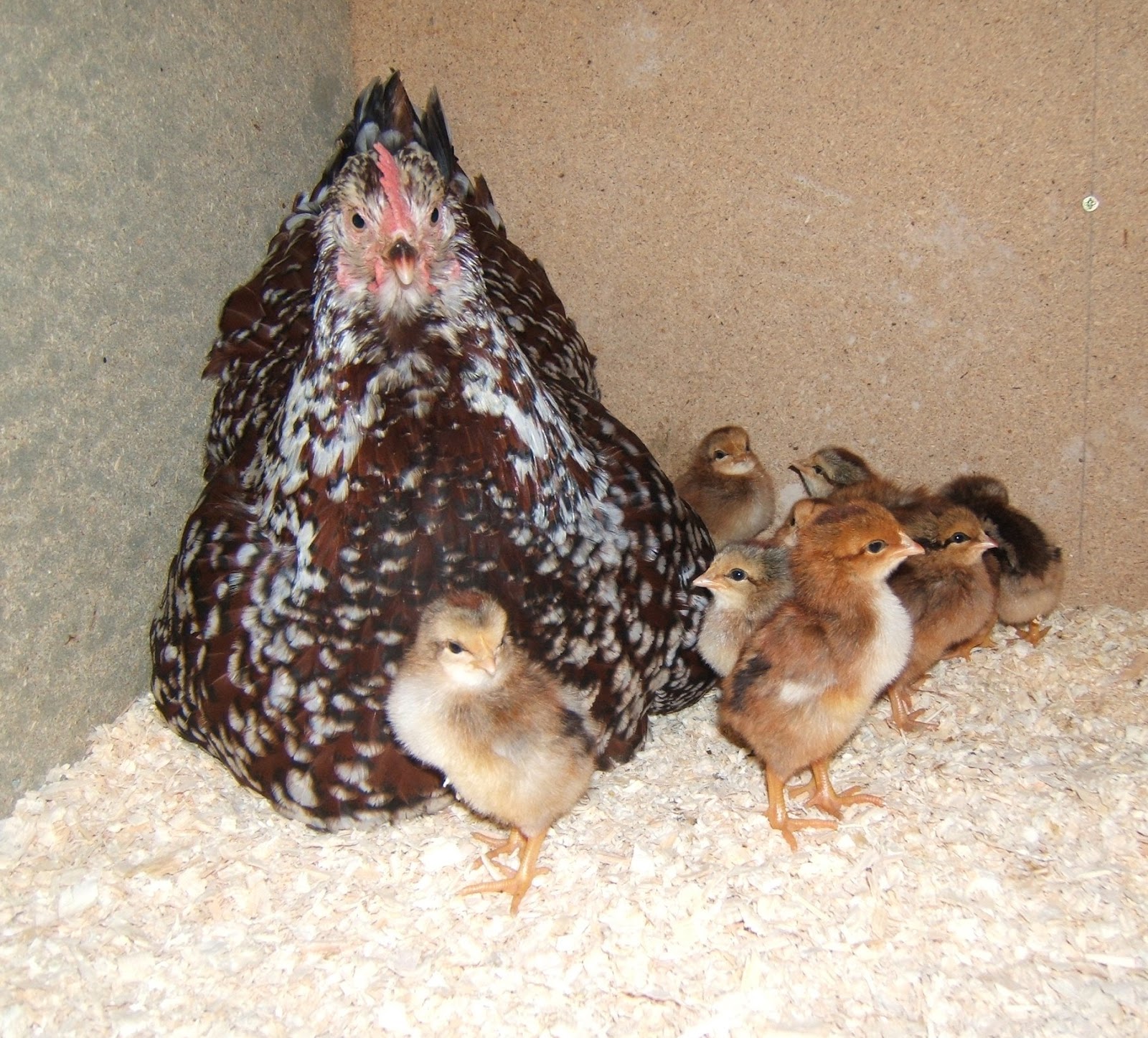
The Indian Game hatched 6 out of the 7 viable Light Sussex eggs over the Easter weekend. A result I am more than pleased with, considering the problems with the air sacs. The chicks are adorable, true little yellow and white 'Easter chicks'. Now 2 1/2 weeks old they are growing strong and feathering up nicely with the black showing through on the wings and hackle, their black eyes quite striking. As ever the Indian Game hen is proving to be a doting mother.
Over the weekend the eggs in the incubator hatched.Numbers were much lower than expected as when I candled the eggs at 7 days many of the Gold Duckwing Welsummer eggs were clear. It seems the senior cockerel is feeling his age.He has now been moved to head my 'broody' flock a mix of heavy breed hens who at this time of year are my star birds and a younger cock has replaced him in the breeding pen. From the incubator 12 of the 15 Exchequer Leghorns hatched and there were 7 Welsummer chicks so still a good result and the chicks now in the shed under a lamp are growing at an alarming rate. It never fails to amaze me just how quickly their wing feathers develop and how instinctively they find food and water, scratch, preen and dust bath.Already they are sparring with one another.
The first hatch of the year are now 10 weeks old and are free ranging the grass pen at home. The young cockerels are finding their voice and one of the Leghorns has taken role as head of the group calling the pullets to him when he finds food.
The cross between the Welsummer cockerel and the Barnevelder hens looks as if it is going to be successful, the pullet is a pretty, friendly hen who hopefully will be a good layer of brown eggs, the cockerels are very strong, solid looking birds and worth growing on for the table.
The Exchequer Leghorn pullets are nicely marked, a good shape, inquisitive and active.and having bred only from the largest eggs hopefully this trait will be passed onto the pullets. They are proving (rightly so) a very popular breed for poultry keepers this year and I have had many enquiries.
The second hatch are 6 weeks old and yesterday the mother hen was moved back into the 'broody' flock and the chicks/growers left to fend for themselves. They don't appear to have noticed her absence, although they are squabbling amongst themselves a little more now she isn't there to intervene. Unfortunately most are cockerels, although I do need a replacement cockerel myself this year and have a couple ordered so not so bad and there are a few nice pullets amongst them. In a couple of weeks time they too can free range.
Finally news on the broody Barnevelder, she has been sitting on 8 eggs; 4 Partridge Welsummer and 4 Maran X Welsummer. They are due to hatch tomorrow and today they have started to pip. At the weekend she will be moved to an ark along with her chicks and the pen in the shed disinfected for the immediate occupation of a Maran and a setting of Exchequer Leghorn eggs.
Monday, 2 April 2012
The incubator is set
If I was superstitious maybe April 1st wasn't the best day to set the incubator but I did. 37 eggs - 15 Exchequer Leghorn and 22 Gold Duckwing Welsummer due to hatch, all being well on St. George's Day, April 23rd.
The incubator is again in the garage, hopefully this time the temperature will remain stable. I think it is running a little cold but I am reluctant to 'fiddle' with the thermostat. The digital thermometer is showing 37 C, the mercury thermometer just on / below the 100F and the strip thermometer is all over the place (I think it got wet last time). One of the many reasons I prefer using broody hens !
The mother hen is doing a sterling job rearing her 3 week old chicks. A challenge last night when temperatures dipped below freezing, turning the grass crisp and white and the drinking water to ice.
The Indian Game broody has only a few more days to go before her eggs are due to hatch but I fear she maybe disappointed. She now only has 7 eggs and I'm still not happy with the air sacs. We will just have to wait and see.
Another hen has gone broody, this time an untried young Barnevelder. She seems determined and has remained settled even after her move to the broody pen. I am trying to order a clutch of Silver Laced Wyandotte eggs to hatch for a friend but with the Easter Bank holidays looming and therefore several days without post I will probably set her on a clutch of Welsummer/Maran eggs of my own.
It looks as if the Silver Grey Dorking is also considering motherhood. If she does go broody I may sell her either with eggs or with chicks. She is a favourite of mine so maybe not, only space is limited.
Saturday, 18 February 2012
3 days old - Exchequer Leghorn
(click on image to enlarge)
3 days on and the chicks are growing fast. They have found their food and water, have learnt to scratch about, have enjoyed a little goose grass and already their wing feathers and characters are developing.
For now they are still under the larger lamp, in a week or so I'll change to the dull emitter lamp so they will experience night and day.
Monday, 13 February 2012
Day 21 - Hatch day
So far 1 Exchequer Leghorn chick out, 3 more pipping. Lets hope for a few more by the morning.
Monday, 30 January 2012
Incubation - Day 7
Today was Day 7 - a week since the eggs were set in the incubator. Time to candle the eggs for the first time since setting to check fertility. I wasn't that hopeful, it is very early in the season and the incubator is sighted in a different place to previous settings. However all 12 of the Exchequer Leghorns were fertile - 100%.
Of the others, it was a little harder to tell. Three of the crossbreeds eggs were clear, one Barnevelder/ Partridge Welsummer was fertile, the others I can't be sure. I'll candle again in a weeks time.
I have been running the incubator dry and was prepared today to add water if I thought it was needed but the air sacs appear to be the right size, so for now I have left it still running dry and will check again on the second candling.
Monday, 21 November 2011
A mixed bag
A month has passed since my last post, so just a few snippets of poultry news.
The Gold Duckwing Welsummer flock are slowly coming out of moult, new feathers are emerging daily and in a few weeks they should all be showing off their glossy new plumage. They have yet to come back into lay.
The Exchequer Leghorns have already started laying again, having only stopped for a week or two. Their feather drop, apart from one hen was far less dramatic than the Welsummers. They are now in their 2nd year of laying and egg size has noticeably increased.
The broody flock are also coming back into lay, although frustratingly a couple of the hens are laying away. Two lay in the feed store amongst the straw and hay but I have yet to find where the Maran is laying despite many hours wasted scouring the hedge banks and all other likely spots.
The young Partridge Welsummer trio are looking fine. The pullets are laying, albeit sporadically, as are the Barnevelder pullets. The Welsummer cockerel is proving to be friendly to us and a true gentleman to the hens.
The sun at the weekend glistened on his plumage.

The young birds at home have been having the time of their lives, being allowed free range of the garden. They have done a sterling job of grubbing up weeds and bugs amongst the flower border, steps and veg patch.
Their numbers are gradually decreasing as more are sold. I have my eye on a couple of the Leghorn pullets I am debating on keeping, they are such friendly birds and their markings are very good.

At the weekend we weighed the turkeys. As they are more slender than previous years and so much lighter on their feet we were concerned they weren't making good weight. Looks however are deceptive as they are pretty much on par with previous years. The stags are weighing in at approx. 11- 12 kg, the hens 6 - 7 kg. and we still have four weeks to go.
The Gold Duckwing Welsummer flock are slowly coming out of moult, new feathers are emerging daily and in a few weeks they should all be showing off their glossy new plumage. They have yet to come back into lay.
The Exchequer Leghorns have already started laying again, having only stopped for a week or two. Their feather drop, apart from one hen was far less dramatic than the Welsummers. They are now in their 2nd year of laying and egg size has noticeably increased.
The broody flock are also coming back into lay, although frustratingly a couple of the hens are laying away. Two lay in the feed store amongst the straw and hay but I have yet to find where the Maran is laying despite many hours wasted scouring the hedge banks and all other likely spots.
The young Partridge Welsummer trio are looking fine. The pullets are laying, albeit sporadically, as are the Barnevelder pullets. The Welsummer cockerel is proving to be friendly to us and a true gentleman to the hens.
The sun at the weekend glistened on his plumage.
The young birds at home have been having the time of their lives, being allowed free range of the garden. They have done a sterling job of grubbing up weeds and bugs amongst the flower border, steps and veg patch.
Their numbers are gradually decreasing as more are sold. I have my eye on a couple of the Leghorn pullets I am debating on keeping, they are such friendly birds and their markings are very good.
At the weekend we weighed the turkeys. As they are more slender than previous years and so much lighter on their feet we were concerned they weren't making good weight. Looks however are deceptive as they are pretty much on par with previous years. The stags are weighing in at approx. 11- 12 kg, the hens 6 - 7 kg. and we still have four weeks to go.
Monday, 17 October 2011
Quick catch up
Photo: Young Gold Duckwing Welsummer pullets
With so much else happening just lately, posts have been few and far between. Life and routine, in the poultry world, however continues.
Most of the laying hens are now in moult and eggs are at a minimum. The cockerels have lost their grandeur and the hens resemble prickly pin cushions. The Welsummer flock have synchronized their moult, simultaneously dropping the majority of their feathers and all completely off lay. Hopefully it will be a short, sharp moult - the sign of a good layer.
All the 'spare' cockerels are now in the freezer, leaving us with just a couple of young Exchequer Leghorns. These will probably be carried through the winter and assessed early in the New Year, when they have matured a little.
All the growers are now running together in a large grass pen at home. The Gold Duckwing Welsummers, at 13 and 18 weeks old are looking good and are ready to find new homes. I would expect the older ones, at least to come into lay this year.
Photo: Gold Duckwing Welsummer Pullet
A couple of the Indian Game have recently been broody but this has been discouraged as I feel it is too late in the year to rear chicks.
Fianlly - the turkeys. They are growing very quickly and never fail to keep everyone entertained. A bird I thoroughly enjoy keeping and hope to breed one day, rather than just rearing for Christmas.
Friday, 2 September 2011
Winding down for Autumn
Autumn has come early this year. There is a nip in the air, the leaves are beginning to turn, hedgerow fruits are ripening and dawn breaks with a low mist and pink sky.
The poultry are winding down for a well deserved rest. Many of the older birds are already in moult and egg production has slowed a little. Although egg numbers remain the same, as this years pullets have started to come into lay.
I still have a pen of 9 -10 week old Welsummer chicks and a pen of 7-8 week old Exchequer Leghorn chicks. The mother hens will be removed tomorrow to join the small flock I keep as broody hens. This year they have done me proud, rearing many clutches between them. One Indian Game is still broody but it is too late in the year to rear any more chicks. So for now she sits on a bale of straw in the feed shed on imaginary eggs.
This years cockerels are growing fast, a couple have been sold, the rest are slowly being placed in the freezer.
It has been a good year, with fertility high and many healthy strong chicks hatching. Admittedly the first few hatches were mainly cockerels but subsequent hatches balanced it out.
We have avoided red mite and all illnesses. I'd like to think through careful management and not over stocking but I think luck also plays a part.
It is now time for houses to be treated to help withstand the winter weather and for fences to be repaired or replaced. Also for plans to be put into action for next years breeding season.
The poultry are winding down for a well deserved rest. Many of the older birds are already in moult and egg production has slowed a little. Although egg numbers remain the same, as this years pullets have started to come into lay.
I still have a pen of 9 -10 week old Welsummer chicks and a pen of 7-8 week old Exchequer Leghorn chicks. The mother hens will be removed tomorrow to join the small flock I keep as broody hens. This year they have done me proud, rearing many clutches between them. One Indian Game is still broody but it is too late in the year to rear any more chicks. So for now she sits on a bale of straw in the feed shed on imaginary eggs.
This years cockerels are growing fast, a couple have been sold, the rest are slowly being placed in the freezer.
It has been a good year, with fertility high and many healthy strong chicks hatching. Admittedly the first few hatches were mainly cockerels but subsequent hatches balanced it out.
We have avoided red mite and all illnesses. I'd like to think through careful management and not over stocking but I think luck also plays a part.
It is now time for houses to be treated to help withstand the winter weather and for fences to be repaired or replaced. Also for plans to be put into action for next years breeding season.
Thursday, 18 August 2011
Young stock - For Sale - Photos updated
Now I have decided on next year's breeding groups I have a few young stock hatched this year available for sale.
Turkey Poults - White double breasted 9 weeks old . £10 each SOLD

Gold Duckwing Welsummer:
1 Partridge colour - ( split for Gold Duckwing) pullet 23 weeks old. £18 SOLD

6 pullets 12 weeks old - 5 of which are Gold in colour 1 Partridge (split for Gold ) £15 each
Photos: 11 week old Gold Duckwing Welsummers. 5 Gold
1 Partridge split for Gold (Partridge pullet - sold )


Exchequer Leghorn:
9 chicks unsexed available in a few weeks - hatched 23 July 2011
Turkey Poults - White double breasted 9 weeks old . £10 each SOLD
Gold Duckwing Welsummer:
1 Partridge colour - ( split for Gold Duckwing) pullet 23 weeks old. £18 SOLD
6 pullets 12 weeks old - 5 of which are Gold in colour 1 Partridge (split for Gold ) £15 each
Photos: 11 week old Gold Duckwing Welsummers. 5 Gold
1 Partridge split for Gold (Partridge pullet - sold )
Exchequer Leghorn:
9 chicks unsexed available in a few weeks - hatched 23 July 2011
Monday, 15 August 2011
Next years plan - Breeding flocks
Anyone who has read my blog will know my favourite breed above all else is the Welsummer - a breed that offers all that is required of a hen. Beautiful to look at, friendly, prolific layers of lovely, large dark or speckled brown eggs. Birds happy either free ranging or in a back garden setting. What more could you ask for?
Next year I plan to run 3 breeding flocks.
Flock 1 will be the same group as this year - a 2009 Gold Duckwing Welsummer cockerel with 3 of his daughters. This time however I will use all Partridge (spilt for gold ) in colour or all Gold in colour as I am interested in noting any difference in the offspring of the two colours e.g higher percentage of gold chicks, size of birds, colour of eggs laid by the resulting pullets etc.
Flock 2 will be the son of the 2009 Gold Duckwing Welsummer cockerel hatched in 2010 and as yet untried. I will run him with the hens not used in the above flock i.e the 3 Partridge or the 3 Gold hens. This will be a sibling mating and will more than likely throw up any genetic faults, so careful records will need to be kept and any undesirable birds kept out of any future breeding programme.
Flock 3 will be a trio of Partridge Welsummers.
The Gold Duckwing Welsummer pullets hatched this year I'll keep for a year before adding to any breeding group. I am eargerly awaiting for them to come into lay as there has been mention of Gold Duckwing Welsummer eggs lacking in colour. So far, with the 1st generation hens,(pullets from a Gold Duckwing cockerel to Partridge hens) it is not something I have noticed. The eggs produced have been a good colour, a very good size for 1st year hens and very good in number.
Fertility and hatch rate has been extremely high. The chicks produced, strong and healthy.
The only other breeding flock I will now keep, having decided not to run a 'table bird ' flock will be the Exchequer Leghorns.
My main aim with these is to try to increase egg size. All other traits of the breed I am extremely happy with. Despite their reputation my birds are not at all flighty, they lay well and have good markings, but their eggs are smaller than I would expect from a Leghorn. They are however only 1st year birds so I may be judging them a little unfairly.Once again fertility and hatch rate has been very high and the chicks are adorable.
Next year I plan to run 3 breeding flocks.
Flock 1 will be the same group as this year - a 2009 Gold Duckwing Welsummer cockerel with 3 of his daughters. This time however I will use all Partridge (spilt for gold ) in colour or all Gold in colour as I am interested in noting any difference in the offspring of the two colours e.g higher percentage of gold chicks, size of birds, colour of eggs laid by the resulting pullets etc.
Flock 2 will be the son of the 2009 Gold Duckwing Welsummer cockerel hatched in 2010 and as yet untried. I will run him with the hens not used in the above flock i.e the 3 Partridge or the 3 Gold hens. This will be a sibling mating and will more than likely throw up any genetic faults, so careful records will need to be kept and any undesirable birds kept out of any future breeding programme.
Flock 3 will be a trio of Partridge Welsummers.
The Gold Duckwing Welsummer pullets hatched this year I'll keep for a year before adding to any breeding group. I am eargerly awaiting for them to come into lay as there has been mention of Gold Duckwing Welsummer eggs lacking in colour. So far, with the 1st generation hens,(pullets from a Gold Duckwing cockerel to Partridge hens) it is not something I have noticed. The eggs produced have been a good colour, a very good size for 1st year hens and very good in number.
Fertility and hatch rate has been extremely high. The chicks produced, strong and healthy.
The only other breeding flock I will now keep, having decided not to run a 'table bird ' flock will be the Exchequer Leghorns.
My main aim with these is to try to increase egg size. All other traits of the breed I am extremely happy with. Despite their reputation my birds are not at all flighty, they lay well and have good markings, but their eggs are smaller than I would expect from a Leghorn. They are however only 1st year birds so I may be judging them a little unfairly.Once again fertility and hatch rate has been very high and the chicks are adorable.
Saturday, 2 July 2011
Poultry catch up
Photo: (click on image to enlarge) Young Gold Duckwing Welsummer cockerel - next year's second line.
( his legs are yellow !! )
The last couple of weeks have seen quite a few changes amongst the poultry.
Despite trying various different tactics the Indian Game cockerel remained infertile or at least disinterested. He was young and fit and would chase the girls around the paddock for as long as they would run but as soon as they stopped he walked away. So he is no longer with us.
Next year in his place as head of the table bird flock we will have a Barnevelder cockerel. I have the pick of 5 from this year's hatch but have already marked out the one I think the best.
I am also going to replace the mix of heavy breed layers but am keeping the Marans, Speckled Sussex and Indian Game as they have been star broodies this year. The other layers have already been sold and have gone to a very good home. I will make the numbers up with half a dozen Barnevelder pullets.
All of this year's Exchequer Leghorn pullets have sold and I am still getting enquires for them. Today I set another clutch of eggs under a broody Speckled Sussex. This will probably be my last hatch of the year.
The Gold Duckwing Welsummers have been amazing, they have been laying daily and the egg size and colour is very good. In the past week or so two have gone broody but it is not a breed I would use to sit, especially as this year I have been overwhelmed with broody hens.
The cockerel I kept back from last year is looking good and I have two nice looking pullets amongst the Partridge Welsummer eggs I hatched, so hopefully the makings of a quality second line.

All the rest of the chicks are thriving and as each batch grow and more hatch they are moved along the line of different size runs.
The turkey eggs hatched last Friday 12 out of 13 being shared amongst two hens ..but more about that later along with photos.
The old gander, thankfully, has settled down and seems reasonably happy pottering about with the sheep and hens. He is in full moult and looks a little dishevelled but otherwise none the worse for his ordeal.
Wednesday, 25 May 2011
FOR SALE - Exchequer Leghorn pullets
SOLD:

The Exchequer Leghorn 'chicks' are now 11 weeks old. They are free ranging a large area and are fully independent. The cockerels have started to crow and unfortunately their time is limited.
Despite their reputation as being flighty these birds are quiet and inquisitve. They rush to you rather than away from you, to the extent they are often in danger of being trodden on.
In such a short time they have gone from this...
to this ......

to the fine looking birds in the first photo.
In just a couple of months the pullets should be coming in to lay. Leghorns are early to mature and often start to lay from appproximately 20 weeks of age. They are prolific layers. At first the eggs are quite small but soon become the large pure white eggs the breed is renowned for.
The Exchequer Leghorn 'chicks' are now 11 weeks old. They are free ranging a large area and are fully independent. The cockerels have started to crow and unfortunately their time is limited.
Despite their reputation as being flighty these birds are quiet and inquisitve. They rush to you rather than away from you, to the extent they are often in danger of being trodden on.
In such a short time they have gone from this...
to the fine looking birds in the first photo.
In just a couple of months the pullets should be coming in to lay. Leghorns are early to mature and often start to lay from appproximately 20 weeks of age. They are prolific layers. At first the eggs are quite small but soon become the large pure white eggs the breed is renowned for.
Saturday, 7 May 2011
Chicks become growers
I'm not sure at what age a chick is defined as a grower but as the first hatch are now over 7 weeks old, fully feathered, off heat and independent I guess they are now growers. A few of the cockerels have even attempted crowing, impressive at such a young age despite sounding more like a squeaky wheel than king of the roost.
I am very tempted to allow them more freedom, their pen is becoming a little small, but with a sparrowhawk sitting on the fence posts just waiting for an opportunity to swoop I am reluctant to do so quite yet.
Photo: Growers at 7+ weeks
(click on image to enlarge)
Thursday, 17 March 2011
Exchequer Leghorn - day old
The novice Indian Game broody has done remarkably well, 10 eggs set, 10 fertile. 10 hatched, 10 chicks and so far they are all still alive despite the occasional flattening by a rather heavy footed Mum – thank goodness for soft ground!
Most of the chicks hatched yesterday and by midday today the mother hen decided it was warm enough for a quick explore outside. There was just enough time for a drink and feed before the cry of a buzzard overhead sent them scurrying inside.
Monday, 7 March 2011
Candling Eggs
The weekend saw the 10 day mark for the Exchequer Leghorn eggs under the Indian Game broody. As an untried broody she is behaving remarkably well but so far she has had little to no disturbance. I wasn't sure how she would react to me removing the eggs from under her, albeit very gently and for a minimum of time to enable me to candle them, but she took it in her stride with just a token peck of my hand in protest and then snuggled the eggs back under once they were returned.
All 10 eggs are fertile - 100% - I couldn't ask for more. 100% hatch rate is another matter, there is a while to go yet.
As the eggs are white every detail inside the egg can be seen when they are candled, so unlike the Welsummers, their dark shells making it almost impossible to see anything more than shadow and light.
This morning I also candled the eggs in the incubator. Once again all the Exchequer Leghorn eggs are fertile. It is hard to tell with the Welsummer eggs, a few look as if they may have died in the first few days. I have marked them, returned them to the incubator and will candle again on Day 18.
I had the same problem with the Barnevelder eggs, as they are also dark. These eggs came through the post and despite being very well packed several have ruputured air sacs. Normally I candle posted eggs before incubating but failed to do so this time. I have returned the eggs with the 'dodgey' air sacs back into the incubator, sometimes if they aren't too bad they have a chance of hatching, we'll see. One of the eggs was clear and has been discarded, a few more I am unsure about and will again candle them on day 18.
All of the Indian Game eggs were clear. I know the cockerel is fertile and think the problem arises from having him free ranging with a number of birds. In the next few days I will reorganise the runs and place him into a smaller grass run with just 3 or 4 hens. An excuse to set more eggs in a couple of weeks time.
Subscribe to:
Posts (Atom)