Showing posts with label 2012 hatches. Show all posts
Sunday, 3 February 2013
Welsummer X Indian Game
At 11+ weeks old the cockerels from the Gold Duckwing Welsummer X Light Laced Indian Game hatch are beginning to grow away from the pullets of the same hatch. They are showing promise for good table birds, with strong legs and broad breast.
In a couple of weeks time I'll separate the cockerels from the pullets giving both sexes a chance to reach their full potential.
Of the 17 birds to hatch there are 9 pullets and 8 cockerels. The variety of colour still amazes me and there are some very pretty pullets amongst them.
( Photo:The 3 birds in the foreground / centre of the photo show the variety in colouring of the pullets)
Although birds are often sold as POL at 18 weeks old I think 23+ weeks is probably more realistic for the more traditional breeds of which these are. If so the young pullets should come into lay around Easter time.
Sunday, 6 January 2013
How quick they grow
Today we moved the 'surprise hatch' chicks to the stable.They are now 7 weeks old and fully feathered.They have out grown the poultry shed at home and with the weather being so mild no longer require heat so other than moving them onto grass the stable seemed the best option. For now it is just too wet for them to venture outside but hopefully they will be able to soon.
They have grown well, are very calm and I think a greater number of them are pullets.
Photo 1: Heads up - alert as the neighbouring hens call after laying.
Photo 2 & 3: Becoming braver and finding their food
Photo 4: Exploring their new home
Tuesday, 20 November 2012
Surprise late hatch in photos - for Dad
Day 1:
Day 2-3 :
Day 4 :
Labels:
2012 hatches,
Broody hen,
Gold Duckwing Welsummer,
Indian Game
Monday, 3 September 2012
2012's breeding season has come to an end.
This week will see the final 'sort out' of the seasons growers and chicks. The last of the mother hens are ready to move back to their flock, their chicks now fully feathered. The male chicks will be culled and the females grouped together in one large pen.
The oldest of the Welsummer growers, being kept as future breeding birds are close to POL and will be moved into large grass pens at the yard. Leaving just the last few, younger Welsummer pullets at home.
The Exchequer Leghorns are still waiting for their new house to be put into place and then they too will be moved on.
All the broody arks will be scrubbed and the wood treated, ready for next season. The 'nursery' area left empty to rest over winter.
2012's breeding season has come to an end.
Sunday, 10 June 2012
So far so good
We are now into the second week of June and despite the awful, changeable, unpredictable weather the birds are coping well. Egg numbers are high and the chicks and growers are - growing.
Sales have been amazing with the young birds selling as soon as they are ready and a waiting list for more. I have been hatching all the eggs I can only selling the odd dozen hatching eggs here and there.
There has been a lull in broodies recently so I have had to resort to using the incubator for the turkey eggs. They are due in a couple of weeks along with a few Exchequer Leghorn eggs. It is the first time I have set a mixed hatch a week apart in the incubator, so I hope all goes well.
It will be the last hatching of Exchequer Leghorns this season as I have broken up the breeding pen. I have swapped my breeding cock for a younger cockerel.He is a little younger than I was expecting but if he grows well I may do a late test hatch.
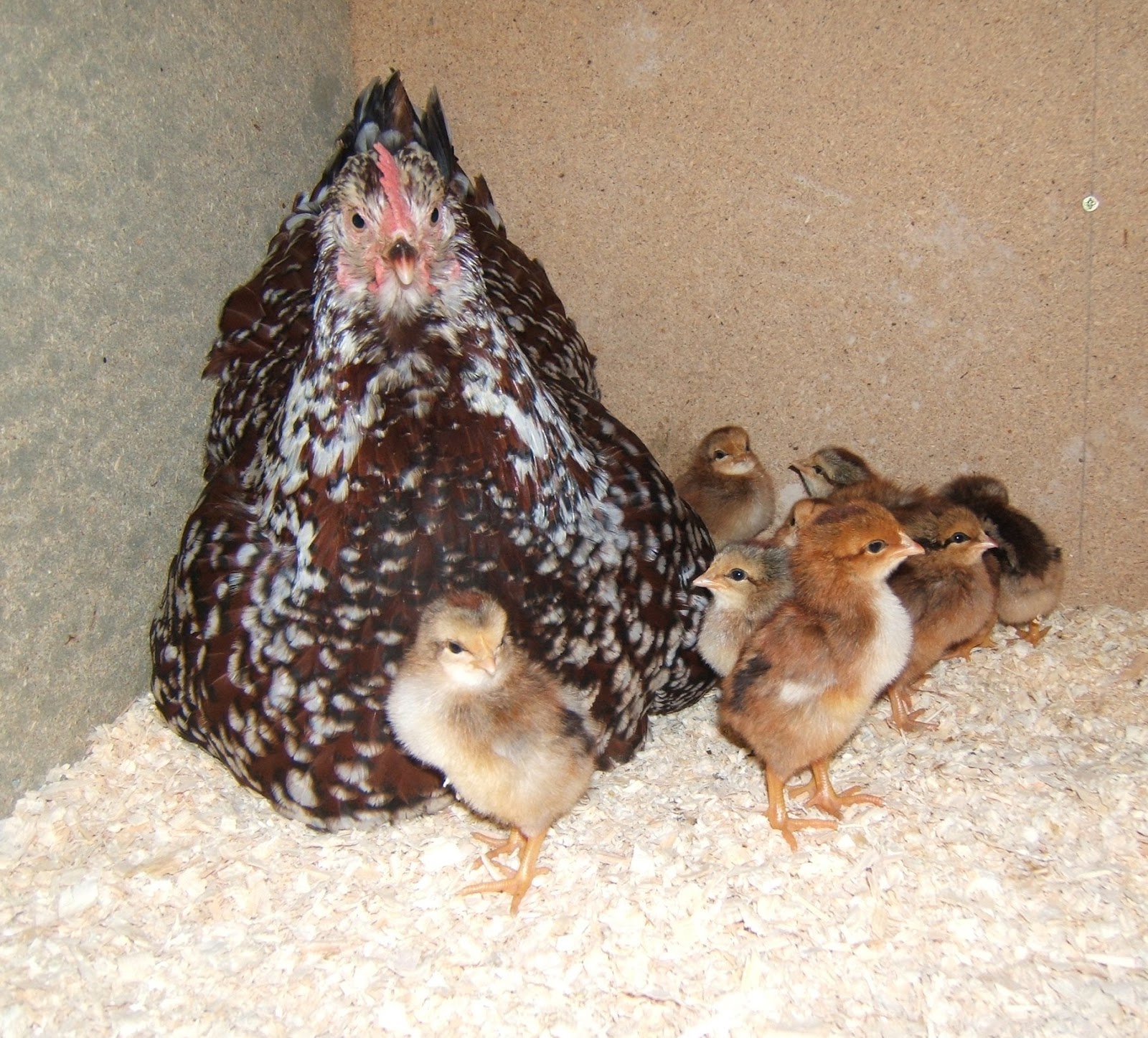
My latest hatch was this weekend - 10 very lively, strong Gold Duckwing Welsummers. They were hatched and will be reared by a Speckled Sussex. From the clutch I hope to keep, possibly 4, of the Silver pullets for myself. I also intend to keep a few of the Exchequer Leghorns that are now 3 weeks old as replacements and a couple of Partridge Welsummer pullets too.
The Light Sussex I hatched from eggs I bought in are now 9 weeks old.I couldn't be more pleased with them, 6 very nice pullets who will become valued members of my laying flock.
I have also kept a pen of different breed cockerels. When they have matured a little I will select a few to keep back, the rest to sell or to put in the freezer.
Wednesday, 25 April 2012
Time for a catch up
My posts are becoming few and far between and at a time when so much is happening, mostly hatching, so time to update the records.
The Indian Game hatched 6 out of the 7 viable Light Sussex eggs over the Easter weekend. A result I am more than pleased with, considering the problems with the air sacs. The chicks are adorable, true little yellow and white 'Easter chicks'. Now 2 1/2 weeks old they are growing strong and feathering up nicely with the black showing through on the wings and hackle, their black eyes quite striking. As ever the Indian Game hen is proving to be a doting mother.
Over the weekend the eggs in the incubator hatched.Numbers were much lower than expected as when I candled the eggs at 7 days many of the Gold Duckwing Welsummer eggs were clear. It seems the senior cockerel is feeling his age.He has now been moved to head my 'broody' flock a mix of heavy breed hens who at this time of year are my star birds and a younger cock has replaced him in the breeding pen. From the incubator 12 of the 15 Exchequer Leghorns hatched and there were 7 Welsummer chicks so still a good result and the chicks now in the shed under a lamp are growing at an alarming rate. It never fails to amaze me just how quickly their wing feathers develop and how instinctively they find food and water, scratch, preen and dust bath.Already they are sparring with one another.
The first hatch of the year are now 10 weeks old and are free ranging the grass pen at home. The young cockerels are finding their voice and one of the Leghorns has taken role as head of the group calling the pullets to him when he finds food.
The cross between the Welsummer cockerel and the Barnevelder hens looks as if it is going to be successful, the pullet is a pretty, friendly hen who hopefully will be a good layer of brown eggs, the cockerels are very strong, solid looking birds and worth growing on for the table.
The Exchequer Leghorn pullets are nicely marked, a good shape, inquisitive and active.and having bred only from the largest eggs hopefully this trait will be passed onto the pullets. They are proving (rightly so) a very popular breed for poultry keepers this year and I have had many enquiries.
The second hatch are 6 weeks old and yesterday the mother hen was moved back into the 'broody' flock and the chicks/growers left to fend for themselves. They don't appear to have noticed her absence, although they are squabbling amongst themselves a little more now she isn't there to intervene. Unfortunately most are cockerels, although I do need a replacement cockerel myself this year and have a couple ordered so not so bad and there are a few nice pullets amongst them. In a couple of weeks time they too can free range.
Finally news on the broody Barnevelder, she has been sitting on 8 eggs; 4 Partridge Welsummer and 4 Maran X Welsummer. They are due to hatch tomorrow and today they have started to pip. At the weekend she will be moved to an ark along with her chicks and the pen in the shed disinfected for the immediate occupation of a Maran and a setting of Exchequer Leghorn eggs.
Monday, 2 April 2012
The incubator is set
If I was superstitious maybe April 1st wasn't the best day to set the incubator but I did. 37 eggs - 15 Exchequer Leghorn and 22 Gold Duckwing Welsummer due to hatch, all being well on St. George's Day, April 23rd.
The incubator is again in the garage, hopefully this time the temperature will remain stable. I think it is running a little cold but I am reluctant to 'fiddle' with the thermostat. The digital thermometer is showing 37 C, the mercury thermometer just on / below the 100F and the strip thermometer is all over the place (I think it got wet last time). One of the many reasons I prefer using broody hens !
The mother hen is doing a sterling job rearing her 3 week old chicks. A challenge last night when temperatures dipped below freezing, turning the grass crisp and white and the drinking water to ice.
The Indian Game broody has only a few more days to go before her eggs are due to hatch but I fear she maybe disappointed. She now only has 7 eggs and I'm still not happy with the air sacs. We will just have to wait and see.
Another hen has gone broody, this time an untried young Barnevelder. She seems determined and has remained settled even after her move to the broody pen. I am trying to order a clutch of Silver Laced Wyandotte eggs to hatch for a friend but with the Easter Bank holidays looming and therefore several days without post I will probably set her on a clutch of Welsummer/Maran eggs of my own.
It looks as if the Silver Grey Dorking is also considering motherhood. If she does go broody I may sell her either with eggs or with chicks. She is a favourite of mine so maybe not, only space is limited.
Monday, 26 March 2012
Fresh Air and Sunshine
At the weekend with the weather improving all the young birds were moved outdoors. They seem to thrive on fresh air and sunshine and despite having plenty of space and ventilation indoors are so much happier with grass beneath their feet and the wind in their feathers.
The older chicks reared under a heat lamp are now 6 weeks old, they are very well feathered and have a coop full of sawdust and straw to keep them warm at night.
Photo: Run for the 6 week old chicks.

The younger chicks have the mother hen to keep them snug and would have gone out earlier had their ark been ready and the weather drier.
Photo: New broody/chick ark costing only £2 for new hinges the rest made from off cuts and odds and ends

The poultry shed is now disinfected and aired ready for the next batch of chicks. I'm already collecting the eggs.
The Indian Game has 2 weeks to go before / if any of her eggs hatch. She will stay with them in the ark and run she is in now (similar to the one above) for the first couple of weeks before being moved into a larger run.
The older chicks reared under a heat lamp are now 6 weeks old, they are very well feathered and have a coop full of sawdust and straw to keep them warm at night.
Photo: Run for the 6 week old chicks.
The younger chicks have the mother hen to keep them snug and would have gone out earlier had their ark been ready and the weather drier.
Photo: New broody/chick ark costing only £2 for new hinges the rest made from off cuts and odds and ends
The poultry shed is now disinfected and aired ready for the next batch of chicks. I'm already collecting the eggs.
The Indian Game has 2 weeks to go before / if any of her eggs hatch. She will stay with them in the ark and run she is in now (similar to the one above) for the first couple of weeks before being moved into a larger run.
Friday, 23 March 2012
Light Sussex
Just over a week ago I received a dozen Light Sussex eggs through the post. They were from an 'online friend', a very experienced breeder whose Light Sussex I couldn't resist. I had planned to concentrate on hatching only from my own birds this year but the photos of his Light Sussex were superb and on all accounts their laying ability excellent. I never have enough eggs to sell at the gate, especially when collecting from the breeding pens for hatching, so good layers are always a welcome addition to the flock.
The eggs arrived beautifully and securely packed, however despite all his efforts one egg was still chipped. Fortunately the broody hen is an Indian Game and 10 eggs is her maximum( it was so difficult choosing which egg not to set ! )
Today, on day 8 I candled the eggs. 2 were clear, another 2 I'm not too sure of. But most worrying of all many of the air sacs appear to be ruptured, most probably due to rough handling by the Post Office. There was nothing more that could be done to secure the eggs for transport that hadn't been done and I rested the eggs for a good 24 hours before setting them under the broody, so now it is an anxious wait until hatch day. I have had eggs with ruptured air sacs hatch before so not all is lost, I may yet have a few stunning birds to add to next years laying flock.
Wednesday, 14 March 2012
Yet more chicks
( Photo: taken Thursday 15th March 2012 10 of 12 chicks)
I knew I was becoming a little slack in my postings recently but I hadn't realised I had left it quite so long.
On Monday the eggs under the broody Speckled Sussex started to hatch, the last little chick emerged late yesterday evening.
As always the Speckled Sussex has been the perfect broody and has won a place in my heart for being so trusting towards me, as I lifted her from her pen each day she was sitting for a break.
Of the 15 eggs set 1 was clear, 1 I found broken in the nest on day 16 (from the smell it had probably stopped developing earlier) and 1 failed to completely hatch. So from 15 eggs 12 beautiful, healthy chicks and from the mix evidence that all the cockerels are fertile.
Eggs set:
5 Gold Duckwing Welsummer - all hatched ( cockerel young one - 2010)
4 Exchequer Leghorn - 3 hatched 1 failed to hatch completely
2 Speckled Sussex hen /Gold Duckwing Welsummer cockerel ( cockerel young one - 2010 ) - both hatched
4 Maran hen / Gold Duckwing cockerel (senior) - 2 hatched 1 clear 1 found broken in the nest on day 16
Tuesday, 21 February 2012
First broody of the year
This morning whilst the broody Speckled Sussex was out pottering about on her daily break, I replaced the china eggs she had been sitting on with a clutch of eggs from a selection I had collected over the past few days.
Photo: Taking a well earned break

Traditionally a clutch is 13, as she is such a large bird I have tried her with 15. ( the Indian Game cover 10 with ease and they are so much smaller) I'm a little hesitant, as if she is unable to cover the eggs comfortably, each egg in turn will get cold as she moves them around. However she appears to be covering them well and looks comfortable. I'll check again in an hour or two.
Photo: Sitting comfortably

The eggs are a mix of breeds to test the fertility of the cockerels. I have added a few Exchequer Leghorns which I know to be fertile, so the hen will have a few chicks at least.
As the hen is in a pen rather than a coop and run, I have been lifting her off daily but for the next couple of days I will leave her to sit as I have noticed when left to their own devices for the first few and the last few days of incubation the hen doesn't leave the nest. She does have room in the pen to leave the nest for a stretch, food and water if she wishes.
I tend not to candle the eggs from under a broody so now it is just a case of waiting 21 days to see what hatches.
Eggs set::
5 Gold Duckwing Welsummer
4 Exchequer Leghorn
2 Speckled Sussex hen - Gold Duckwing Welsummer cockerel
4 Maran hen - Gold Duckwing Welsummer cockerel
Selection of eggs collected to choose from:
Chosen eggs in the nest:
Photo: Taking a well earned break
Traditionally a clutch is 13, as she is such a large bird I have tried her with 15. ( the Indian Game cover 10 with ease and they are so much smaller) I'm a little hesitant, as if she is unable to cover the eggs comfortably, each egg in turn will get cold as she moves them around. However she appears to be covering them well and looks comfortable. I'll check again in an hour or two.
Photo: Sitting comfortably
The eggs are a mix of breeds to test the fertility of the cockerels. I have added a few Exchequer Leghorns which I know to be fertile, so the hen will have a few chicks at least.
As the hen is in a pen rather than a coop and run, I have been lifting her off daily but for the next couple of days I will leave her to sit as I have noticed when left to their own devices for the first few and the last few days of incubation the hen doesn't leave the nest. She does have room in the pen to leave the nest for a stretch, food and water if she wishes.
I tend not to candle the eggs from under a broody so now it is just a case of waiting 21 days to see what hatches.
Eggs set::
5 Gold Duckwing Welsummer
4 Exchequer Leghorn
2 Speckled Sussex hen - Gold Duckwing Welsummer cockerel
4 Maran hen - Gold Duckwing Welsummer cockerel
Selection of eggs collected to choose from:
Sunday, 19 February 2012
New broody pen
Since Tuesday when we brought her back from the yard the broody hen has been sitting in a box on the poultry shed floor, growling at all who enter. Today she has been installed in a new pen, giving both her and us a little peace.
She has been an absolute star, resolutely sitting tight throughout all the noise and 'comings and goings' of building the new pen.
As a rule the broodies usually have an ark with a run attached, on the grass, but despite today being a beautiful spring like day, winter is still with us.
Photo: Pens in the poultry shed
The pens in the poultry shed work really well. Three sides of the shed are insulated for a more stable temperature.
The bottom pen has a removable floor to protect the shed floor. The doors and plinth are removable for easy cleaning and also to extend the pen as the chicks grow. The corners have been rounded off slightly to prevent young chicks from crowding together in the corner risking suffocation
The top pen has a plinth that can fixed behind the doors to stop any chicks from falling out when the doors are opened but which can be removed for ease of cleaning.

As a temporary measure I have draped a cloth over one of the doors to give the broody hen a little privacy.
She has been an absolute star, resolutely sitting tight throughout all the noise and 'comings and goings' of building the new pen.
As a rule the broodies usually have an ark with a run attached, on the grass, but despite today being a beautiful spring like day, winter is still with us.
Photo: Pens in the poultry shed
The pens in the poultry shed work really well. Three sides of the shed are insulated for a more stable temperature.
The bottom pen has a removable floor to protect the shed floor. The doors and plinth are removable for easy cleaning and also to extend the pen as the chicks grow. The corners have been rounded off slightly to prevent young chicks from crowding together in the corner risking suffocation
The top pen has a plinth that can fixed behind the doors to stop any chicks from falling out when the doors are opened but which can be removed for ease of cleaning.
As a temporary measure I have draped a cloth over one of the doors to give the broody hen a little privacy.
Saturday, 18 February 2012
3 days old - Exchequer Leghorn
(click on image to enlarge)
3 days on and the chicks are growing fast. They have found their food and water, have learnt to scratch about, have enjoyed a little goose grass and already their wing feathers and characters are developing.
For now they are still under the larger lamp, in a week or so I'll change to the dull emitter lamp so they will experience night and day.
Wednesday, 15 February 2012
Guardian of the shed
Last night my husband greeted me with "I've got you a chicken (not chocolates or flowers in recognition of Valentines Day), I couldn't call you my phone wasn't working, I can take it back if you don't want it."
Me : "where is it ? "
Him: "On the draining board outside"
I knew straight away he was talking about the ( hopefully) broody Speckled Sussex. She had shown signs of going broody the day before. Unfortunately she was just a day too late for me to foster the newly hatched chicks onto her. She is a wonderful broody and mother and has previously both fostered and hatched many chicks, but expecting her to accept these so soon after being moved was probably a little too much even for her.
So for now she is in a box on the brooder shed floor, growling at all who enter and making visiting the chicks who are in a pen under a lamp near by, interesting to say the least.
First Hatch of 2012
Well it went better than I expected. I was very reluctant to site the incubator in the garage, one hard and fast rule (well maybe not that hard or that fast) of incubating is "if you find a site that gives you successful hatches stick with it."
It was also quite early in the year to begin hatching but of the original 24 eggs set 15/16 were fertile. I say 15 - 16 as the Maran egg was too dark to candle and as yet I haven't broken it open to investigate.
Of the 13/14 viable eggs on day 18 - 12 hatched.
The breakdown:
12 Exchequer Leghorn eggs set: on day 7 all 12 fertile. On day 15 2 had stopped growing. 10 taken through to hatching 1 failed to hatch. 9 live chicks.
3 Barnevelder eggs to a Partridge cockerel: all fertile, all hatched
4 Gold Duckwing Welsummer eggs: all clear
5 Eggs from different breed of hens to the Gold Duckwing Welsummer cockerels: all clear
12 live chicks over all.
Most of them hatched on Day 22 which suggests the incubator was running a little cold. I did struggle to maintain a constant temperature as the room was so cold, also the incubator was only partially full. It always works better when running at full capacity.
Clearly from these results it was a little early for both the Gold Duckwing Welsummer cockerels. From today I'll start to collect eggs from their pens and try again, this time with my trusted Speckled Sussex who went broody just a day too late to foster these chicks onto her.
Phot:o: A few of the chicks from the 1st hatch of 2012
Tuesday, 14 February 2012
Day 22
10 hatched so far. 8 transferred to the brooder tonight, the latest 2 to hatch are drying out over night in the incubator. 2 more pipping. No movement from the last 2.
More details tomorrow.
Monday, 13 February 2012
Day 21 - Hatch day
So far 1 Exchequer Leghorn chick out, 3 more pipping. Lets hope for a few more by the morning.
Monday, 30 January 2012
Incubation - Day 7
Today was Day 7 - a week since the eggs were set in the incubator. Time to candle the eggs for the first time since setting to check fertility. I wasn't that hopeful, it is very early in the season and the incubator is sighted in a different place to previous settings. However all 12 of the Exchequer Leghorns were fertile - 100%.
Of the others, it was a little harder to tell. Three of the crossbreeds eggs were clear, one Barnevelder/ Partridge Welsummer was fertile, the others I can't be sure. I'll candle again in a weeks time.
I have been running the incubator dry and was prepared today to add water if I thought it was needed but the air sacs appear to be the right size, so for now I have left it still running dry and will check again on the second candling.
Thursday, 26 January 2012
The incubator is on...
.... for the first test hatch of 2012. It is a little earlier in the season than I usually start but the mild winter has lulled me into a false sense of security.
I prefer to hatch using broody hens but my first setting is generally with the incubator. This year the incubator is in the garage. Previous years it has been in the hallway of the house and I have had many successful hatches when sited there, but the constant humming of the machine annoys certain family members so the garage it is. The garage is built into the hillside, so mostly underground, with a stable temperature and so far the incubator is remaining constant.
I set the eggs on Monday 23rd January.
24 eggs: -
12 Exchequer Leghorns.
4 Gold Duckwing Welsummer
8 eggs from various hens running with the young Partridge and Gold DuckwingWelsummer cockerels. These birds will be crossbreeds but should be good layers of brown eggs.
At the beginning of next week I will candle them. Any clear eggs will be removed. For now I am running the incubator dry, if when I candle the eggs the air sac looks a little too large for the dates I'll add a small amount of water to the tray. Then it is just a case of waiting for the 18th day of incubation when I will candle again, remove any non goers, fill the bottom of the incubator with warm water and wait, for hopefully a successful hatch.
If in the meantime any of the hens go broody ( I have a feeling the Speckled Sussex is 'thinking about it ' ) depending on the number of eggs proven to be fertile I will more than likely transfer them across to the hen. If a large number of the eggs are fertile I will probably wait until they hatch and transfer the young chicks across.
2012 breeding season has begun ...hopefully.
Subscribe to:
Posts (Atom)