Showing posts with label Breeding plan. Show all posts
Wednesday, 19 September 2012
Exchequer Leghorn
Next year I will introduce a new cockerel to the breeding flock, it is time for new blood.
The cockerel I have chosen ( I swapped him for my original bird ) is growing well, he is nicely marked, stands and moves well and has a good temperament. For the first year he will run with my 3 year old hens and if he proves himself will be used on this years pullets in 2014.
It will be interesting to see if the sex of the chicks hatched from this mating can be identified by their head markings. Although not recognised as a means of sexing young Leghorn chicks, a very high percentage of the ones hatched from the strain I have appear to follow the rule of 'a spot on the head' or at least a break in the colour between the back of the neck and the head indicates female. The darker the markings the more likely the chick is to be male. Maybe it is just this strain or line of birds who have the trait and by introducing a new blood I will loose it, time will tell.
I will also be keeping a young cockerel from my own birds enabling me to back breed in future years if I wish to do so.
Sunday, 10 June 2012
So far so good
We are now into the second week of June and despite the awful, changeable, unpredictable weather the birds are coping well. Egg numbers are high and the chicks and growers are - growing.
Sales have been amazing with the young birds selling as soon as they are ready and a waiting list for more. I have been hatching all the eggs I can only selling the odd dozen hatching eggs here and there.
There has been a lull in broodies recently so I have had to resort to using the incubator for the turkey eggs. They are due in a couple of weeks along with a few Exchequer Leghorn eggs. It is the first time I have set a mixed hatch a week apart in the incubator, so I hope all goes well.
It will be the last hatching of Exchequer Leghorns this season as I have broken up the breeding pen. I have swapped my breeding cock for a younger cockerel.He is a little younger than I was expecting but if he grows well I may do a late test hatch.
My latest hatch was this weekend - 10 very lively, strong Gold Duckwing Welsummers. They were hatched and will be reared by a Speckled Sussex. From the clutch I hope to keep, possibly 4, of the Silver pullets for myself. I also intend to keep a few of the Exchequer Leghorns that are now 3 weeks old as replacements and a couple of Partridge Welsummer pullets too.
The Light Sussex I hatched from eggs I bought in are now 9 weeks old.I couldn't be more pleased with them, 6 very nice pullets who will become valued members of my laying flock.
I have also kept a pen of different breed cockerels. When they have matured a little I will select a few to keep back, the rest to sell or to put in the freezer.
Thursday, 26 January 2012
The incubator is on...
.... for the first test hatch of 2012. It is a little earlier in the season than I usually start but the mild winter has lulled me into a false sense of security.
I prefer to hatch using broody hens but my first setting is generally with the incubator. This year the incubator is in the garage. Previous years it has been in the hallway of the house and I have had many successful hatches when sited there, but the constant humming of the machine annoys certain family members so the garage it is. The garage is built into the hillside, so mostly underground, with a stable temperature and so far the incubator is remaining constant.
I set the eggs on Monday 23rd January.
24 eggs: -
12 Exchequer Leghorns.
4 Gold Duckwing Welsummer
8 eggs from various hens running with the young Partridge and Gold DuckwingWelsummer cockerels. These birds will be crossbreeds but should be good layers of brown eggs.
At the beginning of next week I will candle them. Any clear eggs will be removed. For now I am running the incubator dry, if when I candle the eggs the air sac looks a little too large for the dates I'll add a small amount of water to the tray. Then it is just a case of waiting for the 18th day of incubation when I will candle again, remove any non goers, fill the bottom of the incubator with warm water and wait, for hopefully a successful hatch.
If in the meantime any of the hens go broody ( I have a feeling the Speckled Sussex is 'thinking about it ' ) depending on the number of eggs proven to be fertile I will more than likely transfer them across to the hen. If a large number of the eggs are fertile I will probably wait until they hatch and transfer the young chicks across.
2012 breeding season has begun ...hopefully.
Monday, 9 January 2012
The chicken shuffle
On Saturday, after the birds had gone to roost we set about re organising their groupings ready for this years breeding season. The birds are quite use to being moved between flocks and adapt readily.
The three Gold Duckwing Welsummer hens (hopefully this years new breeding line) were placed in the paddock flock This flock is headed by the younger of the Gold Duckwing Welsummer cockerels . The cockerel took to the new hens immediately and spent Sunday 'showing' them their new patch..The other hens making up the flock are a variety of heavy, traditional breeds (my broodies).
To balance the numbers, the two Marans from the paddock flock were placed in the house the Gold Duckwing Welsummers came from. This house now consists of the senior Gold Duckwing Welsummer cockerel and three Welsummer hens of partridge colouring but spilt for gold (the original breeding line), plus the aforementioned Marans.
The young trio of Partridge Welsummer and the Barnevelders, making up the third flock, were moved on mass to home.This group will remain together, the Barnevelders are my layers and the Welsummer trio are still quite young to breed from..They were moved as their grass run at the yard was becoming a little worn, where as at home the run is still in good condition., also I miss not having any birds at home, so if the truth be known this move was possibly more for my benefit.
Now all the birds are organised into their new groupings I can start to look forward to the new breeding season.
The three Gold Duckwing Welsummer hens (hopefully this years new breeding line) were placed in the paddock flock This flock is headed by the younger of the Gold Duckwing Welsummer cockerels . The cockerel took to the new hens immediately and spent Sunday 'showing' them their new patch..The other hens making up the flock are a variety of heavy, traditional breeds (my broodies).
To balance the numbers, the two Marans from the paddock flock were placed in the house the Gold Duckwing Welsummers came from. This house now consists of the senior Gold Duckwing Welsummer cockerel and three Welsummer hens of partridge colouring but spilt for gold (the original breeding line), plus the aforementioned Marans.
The young trio of Partridge Welsummer and the Barnevelders, making up the third flock, were moved on mass to home.This group will remain together, the Barnevelders are my layers and the Welsummer trio are still quite young to breed from..They were moved as their grass run at the yard was becoming a little worn, where as at home the run is still in good condition., also I miss not having any birds at home, so if the truth be known this move was possibly more for my benefit.
Now all the birds are organised into their new groupings I can start to look forward to the new breeding season.
Sunday, 11 December 2011
Gold Duckwing Welsummer cockerel
Yesterday I noticed the young Gold Duckwing Welsummer cockerel was limping a little. This morning more so. He appears in fine fettle and is still eagerly chasing and treading the hens. Tonight once he has gone to roost I'll check under his feet for any sores, although I have a feeling the injury is more muscular. If so I will probably house him for a few days, along with a couple of hens, to restrict him and also to keep a closer eye on him. I am hoping to use him next season as the breeding cockerel of my second line of Gold Duckwing Welsummers.
Monday, 15 August 2011
Next years plan - Breeding flocks
Anyone who has read my blog will know my favourite breed above all else is the Welsummer - a breed that offers all that is required of a hen. Beautiful to look at, friendly, prolific layers of lovely, large dark or speckled brown eggs. Birds happy either free ranging or in a back garden setting. What more could you ask for?
Next year I plan to run 3 breeding flocks.
Flock 1 will be the same group as this year - a 2009 Gold Duckwing Welsummer cockerel with 3 of his daughters. This time however I will use all Partridge (spilt for gold ) in colour or all Gold in colour as I am interested in noting any difference in the offspring of the two colours e.g higher percentage of gold chicks, size of birds, colour of eggs laid by the resulting pullets etc.
Flock 2 will be the son of the 2009 Gold Duckwing Welsummer cockerel hatched in 2010 and as yet untried. I will run him with the hens not used in the above flock i.e the 3 Partridge or the 3 Gold hens. This will be a sibling mating and will more than likely throw up any genetic faults, so careful records will need to be kept and any undesirable birds kept out of any future breeding programme.
Flock 3 will be a trio of Partridge Welsummers.
The Gold Duckwing Welsummer pullets hatched this year I'll keep for a year before adding to any breeding group. I am eargerly awaiting for them to come into lay as there has been mention of Gold Duckwing Welsummer eggs lacking in colour. So far, with the 1st generation hens,(pullets from a Gold Duckwing cockerel to Partridge hens) it is not something I have noticed. The eggs produced have been a good colour, a very good size for 1st year hens and very good in number.
Fertility and hatch rate has been extremely high. The chicks produced, strong and healthy.
The only other breeding flock I will now keep, having decided not to run a 'table bird ' flock will be the Exchequer Leghorns.
My main aim with these is to try to increase egg size. All other traits of the breed I am extremely happy with. Despite their reputation my birds are not at all flighty, they lay well and have good markings, but their eggs are smaller than I would expect from a Leghorn. They are however only 1st year birds so I may be judging them a little unfairly.Once again fertility and hatch rate has been very high and the chicks are adorable.
Next year I plan to run 3 breeding flocks.
Flock 1 will be the same group as this year - a 2009 Gold Duckwing Welsummer cockerel with 3 of his daughters. This time however I will use all Partridge (spilt for gold ) in colour or all Gold in colour as I am interested in noting any difference in the offspring of the two colours e.g higher percentage of gold chicks, size of birds, colour of eggs laid by the resulting pullets etc.
Flock 2 will be the son of the 2009 Gold Duckwing Welsummer cockerel hatched in 2010 and as yet untried. I will run him with the hens not used in the above flock i.e the 3 Partridge or the 3 Gold hens. This will be a sibling mating and will more than likely throw up any genetic faults, so careful records will need to be kept and any undesirable birds kept out of any future breeding programme.
Flock 3 will be a trio of Partridge Welsummers.
The Gold Duckwing Welsummer pullets hatched this year I'll keep for a year before adding to any breeding group. I am eargerly awaiting for them to come into lay as there has been mention of Gold Duckwing Welsummer eggs lacking in colour. So far, with the 1st generation hens,(pullets from a Gold Duckwing cockerel to Partridge hens) it is not something I have noticed. The eggs produced have been a good colour, a very good size for 1st year hens and very good in number.
Fertility and hatch rate has been extremely high. The chicks produced, strong and healthy.
The only other breeding flock I will now keep, having decided not to run a 'table bird ' flock will be the Exchequer Leghorns.
My main aim with these is to try to increase egg size. All other traits of the breed I am extremely happy with. Despite their reputation my birds are not at all flighty, they lay well and have good markings, but their eggs are smaller than I would expect from a Leghorn. They are however only 1st year birds so I may be judging them a little unfairly.Once again fertility and hatch rate has been very high and the chicks are adorable.
Wednesday, 25 May 2011
Welsummer - New Blood line
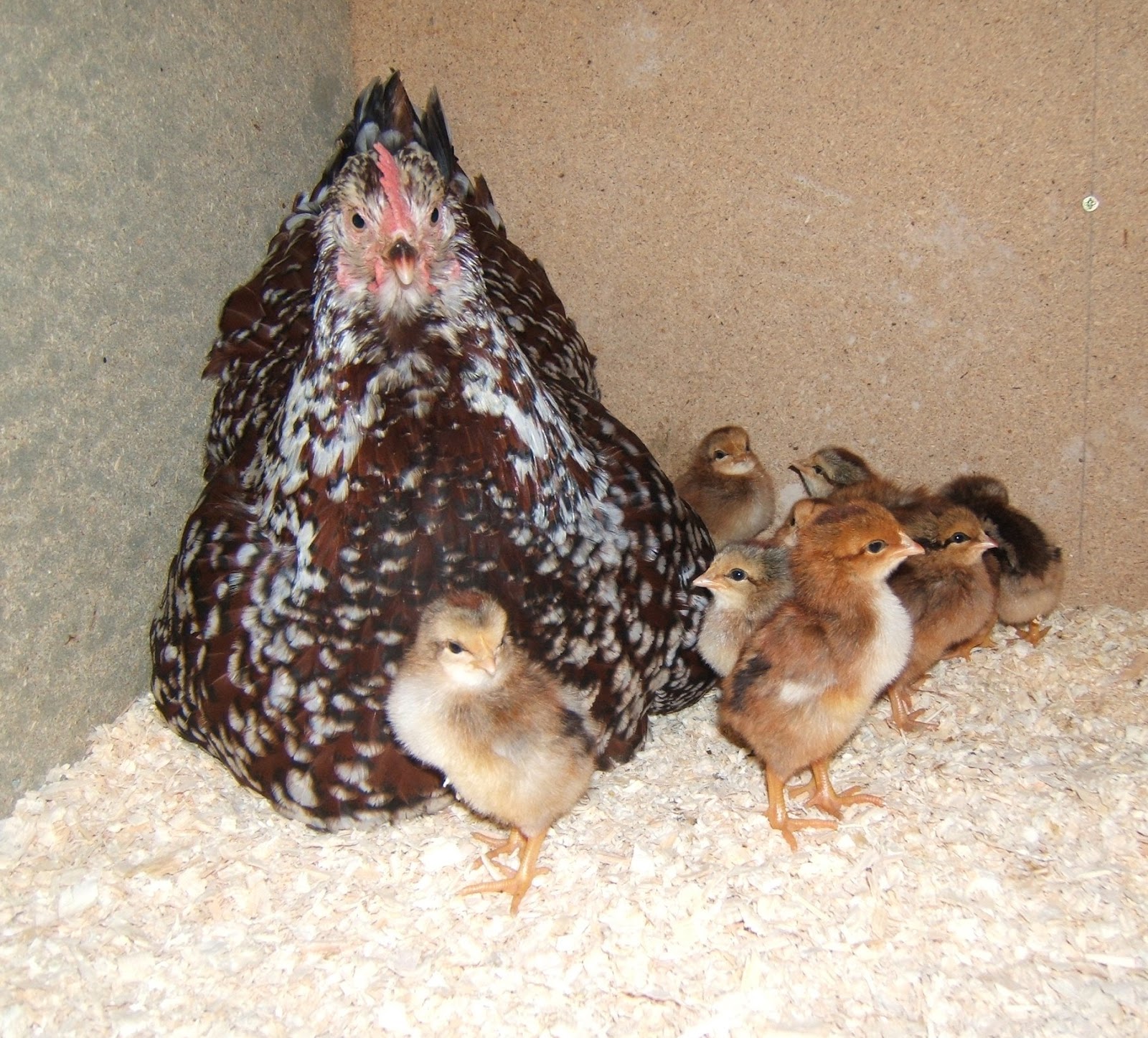
8 little chicks ....the start of my new blood line. (click on image to enlarge)
These eight little chicks are the end result of the two broodies who sat together throughout their incubation.
The hatch went well, each hen having 4 chicks.
Feeling a little guilty, as the hens had been so close, I decided for practical reasons it would make sense for just one of the hens to rear all the young. So one hen was chosen and the other returned to the flock. The chosen hen has taken to motherhood well, the other is still broody, despite being moved and placed in amongst strange hens...she is determined!
The chicks are Partridge Welsummer, hopefully from good parent stock. I will choose a couple of the best pullets to start a new blood line with a Gold Duckwing Welsummer cockerel I kept back from last year's hatch. ( son of my present breeding cock ).
Friday, 29 April 2011
Broody Hens
Photo: Indian Game cross broody hen on Sussex eggs
Mix a traditional heavy breed hen with an Indian Game cockerel, add a little warm weather and you have the perfect recipe for a broody hen and I have plenty.
No sooner do I remove one from the nestbox - to allow those who are still in lay to do so in peace rather than being harranged on entering the pop hole, then another takes up position in the still warm nest of straw in the hope of rearing a brood of her own.
Some I have managed to 'break' by placing them in a small run with fresh water and a little corn, still in view of the other hens but with nowhere to settle comfortably. Others have spent a few days wandering around clucking but have then decided motherhood may not be for them after all. A couple I have allowed to sit, they have successfully raised a brood and have now rejoined the flock.
Yesterday and today I set two more. Both Indian Game cross hens, very determined that motherhood is their role in life. One has been settled in the small ark and run with a clutch of a dozen Sussex eggs, the other in the poultry shed sitting tight on eleven Partridge Welsummer hens, hopefully the beginnings of a new future breeding line of Gold Duckwing Welsummers.
With still more broodies taking up residence in various nestboxes, I need to spend this weekend re arranging the pens. Moving more hens in with the young cockerel and freeing up the pen at home for the young chicks who are fast becoming 'growers'.
Sadly the slim chance of the goose raisng any goslings of her own has been taken away from her. This morning found her nest empty, all five of her carefully hidden eggs missing. The nest was undisturbed and although I can't be sure I do think the guilt rests on the shoulders of a boxer dog from a few houses away who is allowed to roam free, much to the fustration of a neighbouring sheep farmer.
Thursday, 7 April 2011
3 week old chicks
The 1st chicks of the year to hatch are now three weeks old. They are developing well and feathering up nicely. It is interesting to note that the chicks reared artificially are bigger and a little further ahead than those reared by the broody.
The Exchequer Leghorn chicks with the broody hen have been moved into a larger run, freeing the ark for yet another hatch. They seem happy with the extra space and it gives the mother hen room to 'get away' from them and enjoy her dust bath in peace...well for a few moments at least.


The chicks hatched in the incubator are still in the poultry shed. From the start the door has been open during the day and closed at night. With the warm weather of past few days and the fact that they are feathering up nicely I have been turning their heat lamp off during the day. In addition to chick crumbs they enjoy a twice daily feed of dandelion leaves, goose grass and the occasional apple.

The Exchequer Leghorn chicks with the broody hen have been moved into a larger run, freeing the ark for yet another hatch. They seem happy with the extra space and it gives the mother hen room to 'get away' from them and enjoy her dust bath in peace...well for a few moments at least.
The chicks hatched in the incubator are still in the poultry shed. From the start the door has been open during the day and closed at night. With the warm weather of past few days and the fact that they are feathering up nicely I have been turning their heat lamp off during the day. In addition to chick crumbs they enjoy a twice daily feed of dandelion leaves, goose grass and the occasional apple.
Re testing the fertility of the Indian Game cockerel
As I now have a broody ( several in fact) I thought I would take the opportunity to re test the fertility of the Indn Game cockerel. It has been a couple of weeks since he was penned with just four birds. (Actually they have been free ranging again since the weekend as I needed to prepare the stable for the imminent arrival of lambs.)

I chose the Light Laced Indian Game broody as she successfully reared a couple of broods last year.
Yesterday I placed her in the A frame ark in the garden away from the layers.
Last night I gave her a dozen eggs - a mix of Australorp, Speckled Sussex and Ixworth. Each one I gave her she quickly tucked under her, but this morning I realised 12 were just too many for her, so removed three. She is a small bird and the eggs are large, she sits much more comfortably on just 9.
In 10 days time I will candle the eggs and hopefully this time they will be fertile.
I chose the Light Laced Indian Game broody as she successfully reared a couple of broods last year.
Yesterday I placed her in the A frame ark in the garden away from the layers.
Last night I gave her a dozen eggs - a mix of Australorp, Speckled Sussex and Ixworth. Each one I gave her she quickly tucked under her, but this morning I realised 12 were just too many for her, so removed three. She is a small bird and the eggs are large, she sits much more comfortably on just 9.
In 10 days time I will candle the eggs and hopefully this time they will be fertile.
Labels:
2011 Hatches,
Breeding plan,
Broody hen,
Indian Game,
Table birds
Monday, 14 March 2011
Indian / Cornish Game breeding pen
When candling the eggs set as a test hatch last week I was very surprised to discover all the eggs from the Indian Game flock were clear.
The cockerel is still very young, last year was his first year of breeding and fertility was close to 100%.
He has spent the winter free ranging a large area and is very fit and active. The reasons for his lack of fertility could be one or more of many. It is still very early in the season and he is running with quite a large number of hens.
To rule out the more obvious factors I have now housed him in the stable with just four hens - 2 Speckled Sussex, an Australorp and an Ixworth. The whole flock has also been wormed, as a precaution.
He's not very impressed with the arrangements, I have to say. The stable is plenty large enough to house 5 birds, it has a thick covering of straw on the floor for them to scratch about in. There are greens hanging for them to peck at, a large, old apple branch for them to climb on and investigate, a dust bath and ad lib food and of course water but it is not freedom.
It is only a temporary arrangement, in the next couple of weeks I'll set a few more eggs which will hopefully show more promise.
Monday, 7 March 2011
Candling Eggs
The weekend saw the 10 day mark for the Exchequer Leghorn eggs under the Indian Game broody. As an untried broody she is behaving remarkably well but so far she has had little to no disturbance. I wasn't sure how she would react to me removing the eggs from under her, albeit very gently and for a minimum of time to enable me to candle them, but she took it in her stride with just a token peck of my hand in protest and then snuggled the eggs back under once they were returned.
All 10 eggs are fertile - 100% - I couldn't ask for more. 100% hatch rate is another matter, there is a while to go yet.
As the eggs are white every detail inside the egg can be seen when they are candled, so unlike the Welsummers, their dark shells making it almost impossible to see anything more than shadow and light.
This morning I also candled the eggs in the incubator. Once again all the Exchequer Leghorn eggs are fertile. It is hard to tell with the Welsummer eggs, a few look as if they may have died in the first few days. I have marked them, returned them to the incubator and will candle again on Day 18.
I had the same problem with the Barnevelder eggs, as they are also dark. These eggs came through the post and despite being very well packed several have ruputured air sacs. Normally I candle posted eggs before incubating but failed to do so this time. I have returned the eggs with the 'dodgey' air sacs back into the incubator, sometimes if they aren't too bad they have a chance of hatching, we'll see. One of the eggs was clear and has been discarded, a few more I am unsure about and will again candle them on day 18.
All of the Indian Game eggs were clear. I know the cockerel is fertile and think the problem arises from having him free ranging with a number of birds. In the next few days I will reorganise the runs and place him into a smaller grass run with just 3 or 4 hens. An excuse to set more eggs in a couple of weeks time.
Saturday, 26 February 2011
First incubator setting of 2011
This morning I filled the incubator with eggs - 41 - a mix of my own Gold DuckwingWelsummer eggs, Speckled Sussex /Indian Game and a few Exchequer Leghorns. I also added a dozen Barnevelders which I received in the post from a friend. This hatch is mainly to test fertility, so I could end up with just a few....or rather a lot of chicks. My mind is working overtime on where they will all go. I think I have it sorted, in theory at least. In ten days time when I candle the eggs I will know the maximum number of chicks likely to hatch and can work from there. The poultry shed used for brooding whilst they need heat has plenty of space. Once outside I may need another house to be built, I'll mention that to my husband at a later date.
Monday, 21 February 2011
Collecting eggs for hatching
The breeding season here has begun. On Saturday an Indian Game went broody. Her timing couldn't have been more perfect. Today I am starting to collect eggs to set in the incubator at the end of the week. As the Indian Game is an untried broody, if for any reason she gives up sitting I will be able to transfer the eggs to the incubator, if she takes a dislike to the chicks they can go in the brooder along side the others. On the flip side if I get a poor hatch rate from the incubator any chicks maybe able to be fostered onto the broody.
So for now the little Indian Game is sitting very tightly in an ark at home. If she remains settled and all the signs are that she will, I will give her a clutch of Exchequer Leghorn eggs mid week.
The weather forecast for this week is warm and wet, ideal growing conditions for grass. With this in mind I decided at the weekend to move all the hens into fresh runs, giving their old pens a rest and a chance for the grass to grow. We are very fortunate in having very free draining ground, so mud is rarely a problem, it is just I do like the runs to have a good covering of grass for the birds.
Hopefully by moving the flocks I won't have put them off lay as I am looking forward to selecting a good number of eggs for hatching.
Photo: Gold Duckwing Welsummer cockerel and a few of the hens.


So for now the little Indian Game is sitting very tightly in an ark at home. If she remains settled and all the signs are that she will, I will give her a clutch of Exchequer Leghorn eggs mid week.
The weather forecast for this week is warm and wet, ideal growing conditions for grass. With this in mind I decided at the weekend to move all the hens into fresh runs, giving their old pens a rest and a chance for the grass to grow. We are very fortunate in having very free draining ground, so mud is rarely a problem, it is just I do like the runs to have a good covering of grass for the birds.
Hopefully by moving the flocks I won't have put them off lay as I am looking forward to selecting a good number of eggs for hatching.
Photo: Gold Duckwing Welsummer cockerel and a few of the hens.


Sunday, 30 January 2011
A step closer - to hatching
Yesterday we made a final adjustment to the breeding groups and are now a step closer to being able to start collecting the eggs for hatching.
The remaining two meat cockerels were dispatched, enabling us to swap around the Gold Duckwing Welsummer cockerels. Until now the older of the two GDWS was keeping the young table birds in order, with them gone he can now be returned to the breeding pen.
The younger cockerel who had been running with his hatch mates has been given a pen of his own with four lovely crossbred hens. We won't breed from these birds, they will either be sold for 'garden hens' as they have such a lovely friendly nature or we may keep them to form part of a our broody flock, but for now they are keeping the young cockerel happy until we can provide him with a small number of Welsummer hens of his own.
In two or three weeks we should be able to start collecting the Welsummer eggs with the confidence that they are fertile to the older cockerel.
Breeding from the Indian Game cockerel is slightly more involved. I prefer to pen him with just a few hens at a time, to help increase the fertility percentage but mostly to be able to keep an accurate record of any chicks hatched.
The Exchequer Leghorn flock are really beginning to look stunning and are producing four eggs a day from five birds, all of which are a good size. One of the five hens isn't suitable for breeding so will be moved to the 'laying' flock at home, although I think she is the one bird not laying, so her future is undecided.
The remaining two meat cockerels were dispatched, enabling us to swap around the Gold Duckwing Welsummer cockerels. Until now the older of the two GDWS was keeping the young table birds in order, with them gone he can now be returned to the breeding pen.
The younger cockerel who had been running with his hatch mates has been given a pen of his own with four lovely crossbred hens. We won't breed from these birds, they will either be sold for 'garden hens' as they have such a lovely friendly nature or we may keep them to form part of a our broody flock, but for now they are keeping the young cockerel happy until we can provide him with a small number of Welsummer hens of his own.
In two or three weeks we should be able to start collecting the Welsummer eggs with the confidence that they are fertile to the older cockerel.
Breeding from the Indian Game cockerel is slightly more involved. I prefer to pen him with just a few hens at a time, to help increase the fertility percentage but mostly to be able to keep an accurate record of any chicks hatched.
The Exchequer Leghorn flock are really beginning to look stunning and are producing four eggs a day from five birds, all of which are a good size. One of the five hens isn't suitable for breeding so will be moved to the 'laying' flock at home, although I think she is the one bird not laying, so her future is undecided.
Wednesday, 19 January 2011
Poultry genetics - Comb type
I am trying to get to grips with genetics. I have always known when breeding you only breed from the best and closest to 'type' as possible. Common sense really.
This year the Indian game cockerel threw a couple of single combed offspring - pea comb being the standard for the breed. Even though the Indian Game pullet has beautiful markings, is a good size and shape and has already come into lay, I won't breed her back to the cockerel. I am however intrigued at the genetic make up of the birds and in the likely percentage of this happening again.
As I understand it this is how it works.
Despite the diversity of comb shapes all types can be traced back to just two genes the Pea comb gene and the Rose comb gene, both of which are located on different chromosomes - each chromosome having two genes. Therefore each bird has a total of four genes, these determine its comb type, depending on the dominant gene (or lack of )
The genes can be represented by P (dominant) or p (recessive) for Pea comb and R (dominant) or r (recessive) for Rose comb.
If a dominant gene is present in the birds make up only one is needed for the trait (ie comb shape) to be expressed.
Working backwards we know a single comb type can only be produced by all recessive genes being present i.e the pullet must have the genetic make up for comb type of (pp) (rr)
The parents therefore have the genetic make up (Pp) (rr), both showing Pea comb because of the Dominant (P) gene but carrying mostly recessive genes. This will result in a 25% chance of the offspring having the single comb.
This can been shown as below using The Punnet Square.
If I were to breed the single comb pullet back to the father the chance of a single combed bird being produced would be 50%
All the young hatched this year with a pea comb,carry either the genes (PP) (rr) or (Pp) ( rr ).
If the birds with the genetic make up of (PP) (rr) were to be bred back to their father all the offspring would carry at least one dominant gene for Pea comb.
With careful selection over the next few years I should have a flock of birds that carry only the Dominant Pea comb gene.
This year the Indian game cockerel threw a couple of single combed offspring - pea comb being the standard for the breed. Even though the Indian Game pullet has beautiful markings, is a good size and shape and has already come into lay, I won't breed her back to the cockerel. I am however intrigued at the genetic make up of the birds and in the likely percentage of this happening again.
As I understand it this is how it works.
Despite the diversity of comb shapes all types can be traced back to just two genes the Pea comb gene and the Rose comb gene, both of which are located on different chromosomes - each chromosome having two genes. Therefore each bird has a total of four genes, these determine its comb type, depending on the dominant gene (or lack of )
The genes can be represented by P (dominant) or p (recessive) for Pea comb and R (dominant) or r (recessive) for Rose comb.
If a dominant gene is present in the birds make up only one is needed for the trait (ie comb shape) to be expressed.
Working backwards we know a single comb type can only be produced by all recessive genes being present i.e the pullet must have the genetic make up for comb type of (pp) (rr)
The parents therefore have the genetic make up (Pp) (rr), both showing Pea comb because of the Dominant (P) gene but carrying mostly recessive genes. This will result in a 25% chance of the offspring having the single comb.
This can been shown as below using The Punnet Square.
Punnett Square Calculator - Two traits, Autosomal
| Parents | |
|---|---|
| Parent (top): | AA Aa aa |
| BB Bb bb | |
| Parent (left): | AA Aa aa |
| BB Bb bb | |
| Traits | CC | Cc | cc |
|---|---|---|---|
| Dominant A | |||
| Co-dominant A | |||
| Recessive A | |||
| Dominant B | |||
| Co-dominant B | |||
| Recessive B |
| Punnett Square | ||||
|---|---|---|---|---|
| Ab | Ab | ab | ab | |
| Ab | AAbb | AAbb | Aabb | Aabb |
| Ab | AAbb | AAbb | Aabb | Aabb |
| ab | Aabb | Aabb | aabb | aabb |
| ab | Aabb | Aabb | aabb | aabb |
| Frequencies | |
|---|---|
| AAbb | 4 |
| Aabb | 8 |
| aabb | 4 |
If I were to breed the single comb pullet back to the father the chance of a single combed bird being produced would be 50%
All the young hatched this year with a pea comb,carry either the genes (PP) (rr) or (Pp) ( rr ).
If the birds with the genetic make up of (PP) (rr) were to be bred back to their father all the offspring would carry at least one dominant gene for Pea comb.
With careful selection over the next few years I should have a flock of birds that carry only the Dominant Pea comb gene.
Sunday, 9 January 2011
Breeding pens and reducing cockerel numbers
Yesterday the sun was shining for the first time in what seems like weeks. We spent the day almost entirely with the poultry.
We reduced the table cockerel numbers by four. Their weights, we thought were a little disappointing. Both of the Australorp cross IGs were 6 1/2 lbs and the Ixworth crosses were 6 1/4lbs. There seemed to be no fat on the birds at all.
Next time we will, maybe, give them less freedom, especially in their last few weeks.
We also culled the two spare Exchequer Leghorn cockerels. This has left a lovely looking breeding group.
After cleaning, scrubbing and disinfecting all the poultry houses the birds were moved after they had gone to roost.into their correct breeding groups.This morning they all seemed perfectly happy with their new arrangements.
I have, so far for this year - a breeding group of
An Exchequer Leghorn cockerel running with 5 hens
A Gold Duckwing Welsummer cockerel running with 6 hens
An Indian Game cockerel running with 4 hens.
The Indian Game cockerel will also be penned at various times with a mix of heavy breed hens for traditional table bird crosses.
The hens are all coming into lay and the cockerels are treading well, so soon I will be able to set a couple of test hatches.
Sunday, 2 January 2011
Planning for the breeding season
Despite many weeks of freezing temperatures, ice and snow at the end of 2010 and the New Year starting dull and wet, the cockerels are in fine form and raring to go. Most of last year's pullets are now in lay and the older birds have finished their moult and are looking neat and tidy.
We still have an excess of cockerels. We never managed to deal with all the table birds before Christmas and kept several of the young breeding cockerels back, waiting until they had matured more before making a decision on which to keep.
One of the Exchequer Leghorn cockerels stood out from the rest, making our choice easy. His colouring is good, he matured earlier than the others, is treading the hens frequently and is quite spell bounding, strutting around with an air of confidence and arrogance
Photo: Exchequer Leghorn cockerel 2010 hatch.
The Gold Duckwing Welsummers are proving to be everything I could wish for. The pullets are laying large dark eggs on an almost daily basis. The birds themselves are quiet and friendly, crouching as I enter the pen and happy to be handled. The cockerel I kept from last year's hatch is stunning and despite not using him as this year's breeding cock I am reluctant to part with him and am considering developing a second line.Photo: Gold Duckwing Welsummer cockerel 2010 hatch with an Indian Game pullet and a crossbred pullet.
I will use the same Indian game cockerel as last year. He is still very young and produced many good birds. We are keeping two of his pullets, the young cockerel will either be advertised for sale along with other birds or put into the freezer.
Photo: Indian Game cockerel in full cry. 2010 hatch.
Tuesday, 23 November 2010
Pullet Eggs
This year's pullets are steadily coming into lay. The Exchequer Leghorns started to produce at 22 weeks old and lay most days. For a small bird their eggs are a good size and will get bigger as the birds get older.
At 30 weeks old the Welsummers were a little later than the Exchequer Leghorns but from the start the size of their eggs have amazed me.
Photo: Pullet eggs: White -Exchequer Leghorn; Tinted/cream - Indian Game cross breeds; Brown - Welsummer

I am hoping to breed from the Gold Duckwing Welsummers and will keep a record of each of the birds in the aim of producing a healthy, strong egg laying line. As I only have a small flock and each bird lays slightly different coloured eggs I should soon be able to differentiate between them without trap nesting. However I think the birds have already cottoned on and are sabotaging my plans. They enter the nest box two at a time but only one lays, they then both come out calling with pride. It may take a little longer than I first thought.
Photo: Welsummer pullet eggs. (so much darker than they appear in the photo)
At 30 weeks old the Welsummers were a little later than the Exchequer Leghorns but from the start the size of their eggs have amazed me.
Photo: Pullet eggs: White -Exchequer Leghorn; Tinted/cream - Indian Game cross breeds; Brown - Welsummer
I am hoping to breed from the Gold Duckwing Welsummers and will keep a record of each of the birds in the aim of producing a healthy, strong egg laying line. As I only have a small flock and each bird lays slightly different coloured eggs I should soon be able to differentiate between them without trap nesting. However I think the birds have already cottoned on and are sabotaging my plans. They enter the nest box two at a time but only one lays, they then both come out calling with pride. It may take a little longer than I first thought.
Photo: Welsummer pullet eggs. (so much darker than they appear in the photo)
Tuesday, 9 November 2010
Autumn sort out
We spent the weekend sorting out the poultry.
The cockerels from this years hatch are beginning to mature so we have started to reduce the numbers. On Friday we dispatched four of the oldest - 3 Welsummer and 1 Indian Game Ixworth cross. We weren't expecting much from the Welsummer birds but we were disappointed with the final dressed weight of the IG/IX.
With hindsight they were given far too much space to roam and also ran with the young POL birds. I am reluctant however to house them as it is moving away from my idea of raising birds with as much freedom as possible.
The remaining younger cockerels are now running separately from the pullets and have the run of only one pen, possibly still larger than recommended but a compromise.
Although not as large as we had hoped, the conformation of the IG/IX was good with more breast meat and larger thighs then the Welsummer, who are in reality a laying strain.
Amongst the next batch of cockerels are 2 Indian Game cross Australorp birds who already are much larger and heavier than the other breeds. Definitely the way to go.
Most of this years pullets are now running together in a fresh pen. They have settled in well and look close to lay. I am keeping 6 of the Welsummers to breed from, the rest of the birds will join the laying flock for the time being.
The Exchequer Leghorns have also been moved to a new pen and other than making a decision on which of the cockerels to keep will now remain together as a breeding group. Yesterday, at 22 weeks old one of the pullets laid her first egg. A good size for a first egg from a small bird. They are showing promise.
The older hens are still at various stages of moult. The few that have completed their moult are looking very smart and their fine appearance exaggerates the sorry state of the rest. One poor Light Sussex lost most of her feathers in one go and now they have started to grow back resembles a young prickly hedgehog.
With just the layers and the Indian Game left to sort and move we are now almost organised for the coming months.
The cockerels from this years hatch are beginning to mature so we have started to reduce the numbers. On Friday we dispatched four of the oldest - 3 Welsummer and 1 Indian Game Ixworth cross. We weren't expecting much from the Welsummer birds but we were disappointed with the final dressed weight of the IG/IX.
With hindsight they were given far too much space to roam and also ran with the young POL birds. I am reluctant however to house them as it is moving away from my idea of raising birds with as much freedom as possible.
The remaining younger cockerels are now running separately from the pullets and have the run of only one pen, possibly still larger than recommended but a compromise.
Although not as large as we had hoped, the conformation of the IG/IX was good with more breast meat and larger thighs then the Welsummer, who are in reality a laying strain.
Amongst the next batch of cockerels are 2 Indian Game cross Australorp birds who already are much larger and heavier than the other breeds. Definitely the way to go.
Most of this years pullets are now running together in a fresh pen. They have settled in well and look close to lay. I am keeping 6 of the Welsummers to breed from, the rest of the birds will join the laying flock for the time being.
The Exchequer Leghorns have also been moved to a new pen and other than making a decision on which of the cockerels to keep will now remain together as a breeding group. Yesterday, at 22 weeks old one of the pullets laid her first egg. A good size for a first egg from a small bird. They are showing promise.
The older hens are still at various stages of moult. The few that have completed their moult are looking very smart and their fine appearance exaggerates the sorry state of the rest. One poor Light Sussex lost most of her feathers in one go and now they have started to grow back resembles a young prickly hedgehog.
With just the layers and the Indian Game left to sort and move we are now almost organised for the coming months.
Subscribe to:
Posts (Atom)