TRADITIONAL BREEDS TRADITIONAL WAYS

Showing posts with label Behaviour. Show all posts

Monday, 3 January 2011

Little Black Hen


Our little black hen is a law onto herself... a free spirit. She hatched a couple of years ago from a mixed clutch of eggs I had bought from a local breeder. The eggs were supposed to be from breeds suitable for rearing for the table.
It was clear from very early on that she was a cross bred hen, possibly of Leghorn decent and therefore more favoured towards laying than fattening.

From the start her spirit shone through, which combined with proving herself to be an exceptional layer secured her a place in a flock that originally was to be of true breeds only.

She has lived for the past year with the 'table bird' flock, having free range of a large area. Some days she chooses to mix with the flock, responding to the call of the Indian Game cockerel and roosting at night with them in the safety of the house. Other days she wanders alone and roosts at night on the rafters of the feed barn.
For the past week she has taken herself off each morning to the churchyard, where she happily spends the day, only returning occasionally to feed on the corn offered.

In the next few weeks my plan is to put together the breeding groups, the little black hen was to come home and live with the 'layers', however I am reluctant to restrict her freedom.

Photos:
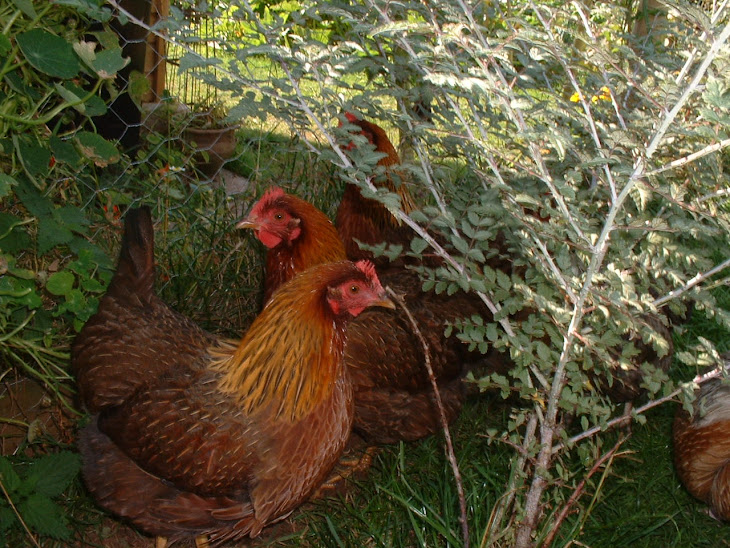
1. Little black hen with part of the flock.


2: Already plotting her escape.


3: Maybe this way, through the apiary ?

Friday, 22 October 2010

Integrating new birds


The two maran pullets have been with us for almost 2 weeks. At first they were isolated in a house and run in the garden, away from the rest of the flock. This gave me and them the opportunity to become familiar with one another and to establish a routine. Mostly though it allowed time for any symptoms of illness to show.


Yesterday evening, after they had gone to roost, I moved them into a larger house
and run within the general pen. This will help the birds to become use to one another before they are integrated fully.

On waking the established flock were non too pleased to discover 2 strangers in their midst and have been complaining loudly all day, running to the gate each time I go in to express their displeasure.


After a few more days I will open the run door and the birds can mix at will. From past experience I have noticed any newcomers, although happy to mix during the day prefer to roost in their old house before building up enough confidence to join the main flock at night. This is fine by me, they can have as much time as they feel they need.


The 'welcoming' committee.

Friday, 24 September 2010

Chicks 3 weeks old

The latest hatch are now 3 weeks old and are beginning to show their individual personalities.

The young Barnvelder X cockerel is the most independent, preferring to scavenge for his own food and rarely coming to the call of food from his mother. Although he does respond instinctively to any warning cry from her.

Photo: Mr. Independent


The little Cream Legbar cockerel is quiet but adventurous. The other morning I found him on the outside of the run, having found and squeezed under the tiniest of gaps. When I opened the door he simply walked back in as if he had done it a dozen times before.

The remaining four Barnvelder and Barnebars stick together and are more often found close to the mother hen, either riding on her back or brooding amongst her feathers.

Photo: Discovering the delight of an apple


All six are extremely confident and friendly, happy to climb into the palm of any hand that offers food.

Although the weather has turned quite cold, it remains on the whole dry. The wet is much harder for the chicks to cope with than the cold and the mother hen is doing a fine job of brooding them.

Photo: Fluffed up for warmth, protection from the cold wind.


Monday, 20 September 2010

All is not well...

....with the Welsh Black hen.

Yesterday she twice came out from the hay bales, within an hour, announcing to the world she had laid an egg. There was not an egg in sight. Concerned she maybe be egg bound I kept a close eye on her all day. She appeared fine going about her daily business as usual and then mid afternoon she dropped a shelless egg in the middle of the paddock. Surprised she turned to have a quick look and then wondered off to join the others. Thank goodness she wasn't egg bound after all.

This morning she was behaving strangely, dropping her wing and circling an Indian Game hen in the same manner as the cockerel.

The Welsh Black came to us at the start of the year on a clutch of eggs. She proved to be a fantastic mum and is a very friendly bird. She has however, never been a very reliable layer, unusual for her breed and the eggs she did lay had poor quality shells.

I have only set and hatched one egg from her, due to the quality of the eggs. The chick hatched with very little down on it's back and is small in comparison to the other chicks from the same hatch and also from expectation of the breed.

She is a fine looking bird, with glossy feathers, a red comb and always active. Looking at her she is a good representative of her kind but something is not right with her.

I will keep her for now, as she is well but will watch her carefully and I certainly won't breed from her.

Thursday, 19 August 2010

Poultry talk


Although I still have one broody sitting on a clutch of eggs, the season is coming to an end. Several of the birds have gone into moult, a few have just a little feather loss, others like the Speckled Sussex and Dorking stand with a pile of feathers surrounding them, loosing more each time they shake. The Ixworth appears to have completed her moult and is looking very smart, crisp and white.

The geese are also moulting, their feathers covering the orchard.

The growers are.... well growing. The cockerels especially are looking fine with their adult feathering coming through.

All the birds are enjoying the start of Autumn with windfall apples and plums plentiful. Everyday when I change the geese' water there is a collection of plum stones at the bottom of the pond. Watching them 'apple bob' never fails to make me smile.

This morning I watched and wondered why all the hens were gathered under the churchyard hedge, until I noticed a pigeon flying out from the elder bush scattering berries everywhere. The hens fought over every last one.

Time has also come for some hard decision making, which birds of the flock to keep and who to replace.


Monday, 9 August 2010

Breaking a broody

Two Indian Game hens have gone broody over the past few days. It is late in the season and I have restricted accommodation for growers, so as tempting as it is to set another clutch I mustn't. Also the hens have already reared a good brood this year.

I need to break them. To begin with I try the gentle approach, removing them from the nest as often as I pass and making sure all eggs are collected as soon as possible after being laid to avoid temptation. Some times this will work, more often than not it doesn't.

The next stage, a final resort, is to put the broody hen into a large dog cage, which is placed just inside the open barn. She is sheltered from the weather but can see the rest of the flock, she has food and water available at all times and twice a day whilst we feed and water the other livestock, we take her out and place her in the paddock with the others. For the first couple of days the broody will take this opportunity to dust bathe but soon scuttles back to a cosy corner in the hay. We place her back into the cage. Usually by the third day she is happy to stay out with the rest, even though she can be heard still making the familiar broody cluck. A week or so later she usually comes back into lay.

We have been fortunate in that both broodies have chosen to nest in the yard, the flock is free ranging and if they had chosen to nest away we possibly wouldn't have found them, leaving them vulnerable to predators.

Monday, 26 July 2010

Gobbling


This morning rather than being greeted by the turkey poults with their soft 'baby' whistle we were treated to their first attempts at gobbling. They are growing up. We also removed the Speckled Sussex from the stable and returned her to the flock, another land mark in their development. From now on they are on their own.


The Speckled Sussex was ready to leave them, hanging by the door to be let out rather than calling the poults to the food. Once out she was greeted by the Indian Game cockerel but was more interested in the fresh grass and a dust bath.

For a hen who has reared two broods this year she is in remarkable condition, most definitely a hen to keep.

Sunday, 25 July 2010

All's well

Just over a week since being injured by a fellow hatch mate, the Indian Game /Australorp grower has regained her confidence and tonight is roosting with the others in the main house.

For the past week she has been roaming with them during the day but has chosen to join the younger Exchequer Leghorn chicks at night.

Tonight when I went to shut them in, instead of waiting for me by the door of the chick's run she was safely snuggled up with the rest of the growers.

Wednesday, 21 July 2010

Crowing

Barely 10 weeks old and one of the Australorp/Indian game growers is attempting to crow. For now it is quite comical. The surprise on it's face was similar to that of a baby when it first shouts and looks around as if to see where the noise came from.

As the growers are 'at home' I am hoping it doesn't become too adept at crowing for a while. We still need to prepare their house and pen at the yard.

Tuesday, 20 July 2010

On the mend

This morning I let the injured grower into the run with her 'hatch mates'. She has stayed close to the perimeter fence and also to the Leghorn chicks all morning, but is happily scratching around in the long grass and old apple branches in search of bugs. The others have completely ignored her, which is far better than attacking her. I will decide this evening if to return her to the safety of the chicks pen for the night or to the main house


Monday, 19 July 2010

Over cautious

The second hatch of Indian Game cross birds are 10 weeks old. Normally by now they would have been free ranging for a couple of weeks but the Sparrowhawk attack made me over cautious and I kept them in an enclosed pen a little too long. The pen is large and they had plenty of room but Indian Game birds like space, plenty of space and the lack of it creates fighting amongst the birds, especially the young cockerels.

On Friday within a couple of hours of all being well amongst the flock I returned to find an Australorp cross bird with a nasty wound to the side of it's head. We immediately isolated her, cleaned the wound, sprayed the area with Septiclean and left her to recover in a pen in the poultry shed. In herself she appeared fine although her eye was closed and I was unable to see how badly damaged it was.


She remained in the pen all Saturday, the wound had dried up remarkably well although her eye was still closed, we sprayed the area again and left her in peace. On Sunday I put her into the main run with the other growers, who were now enjoying their freedom. I was aware that if I isolated her too long from the rest I would have problems with her being accepted again. I'm also a great believer that fresh air, sunshine and company works wonders but with her eye still closed she was vulnerable. I took the decision to put her in with the Exchequer Leghorn chicks. That way she could be seen by the other growers but was safe from any attack. The chicks accepted her immediately and yesterday afternoon her eye opened.

Photos: 1.The injured grower in with the Exchequer Leghorn chicks 2. but still in contact with the rest of her group. 3. showing the injury to her face.


In the next few days I will try to introduce her to the growers again, with plenty of space to escape she should be fine.

A lesson learnt.


Friday, 2 July 2010

Laying away


One of the drawbacks of truly free range poultry is just that..they are free to range. The Indian Game (table bird) flock have freedom of most of our land, the exception being the Welsummer (laying) flock area and the orchard.


With their freedom comes choice, choice to scratch around and feed where they like, choice to find a suitable hiding place to go broody, more often that not amongst the hay bales in the feed shed and choice to the best site to lay.

This is where life becomes difficult for us. For the past couple of weeks egg numbers have dropped dramatically. At first we thought it was a combination of having several hens broody and the time of year, yet somehow the sudden drop didn't seem 'right'. We search all the 'obvious to us' sites but found nothing and then yesterday we spotted a collection of 10 eggs under the hedge in the apiary, laid by three different hens. However this didn't account for all the missing eggs, today another secret site deep in the churchyard hedge. How many more I wonder?

Their house is clean and dark, the nest boxes sufficient in number and frequently doused with mite powder, they just prefer more natural, cool, shady, secretive places I guess.

I am just waiting for the day now when a hen suddenly appears with her brood following along behind.


Wednesday, 5 May 2010

Poultry keeping - the highs and lows


It has been a mixed sort of day today, poultry wise. Despite all my efforts the 'incubator' chicks are still feather pecking. I have covered as many angles as I can think of, extra space, straw flooring, a sand dust bath, greens to peck at and the occasional small handful of scattered grain. The door of the shed is closed to stop any shafts of sunlight, the heat lamp has been raised and at times when warm outside, turned off for short periods. I am at a loss at what to do next. I have ordered a 'natural remedy' anti pecking spray, in the meantime all the chicks are sporting blue backs and tails from the antibiotic spray I use on all the livestock at various times.


As I watch and worry over them I can't help but be aware of the irony that a good percentage of the chicks appear to be cockerels and next week or so, when I am completely sure they will be culled.

One of the broody's chicks is also giving cause for concern. She has injured her foot/leg. It looks slightly bruised and a little swollen just above the middle toe. She is carrying it and only placing it on the ground every now and then. I am not sure how it happened but I think most probably she got caught by the hen, scratching and dust bathing. I don't think it is broken. I will watch her closely to make sure she isn't suffering and that over the next day or so it improves. If it doesn't I'm afraid she will also have to be culled.

Definitely the lows of poultry keeping. On the high - all 9 eggs under the broody Indian Game candled fertile today.

Monday, 3 May 2010

Chicks - 3 weeks old


The incubator chicks are now 3 weeks old, the ones with the Speckled Sussex 3 d
ays younger. The incubator ones seem so much bigger and more advanced...but maybe not. The ones with the broody are certainly much calmer.

Photo: Chicks with broody 3 weeks less 3 days

1 & 2: Indian Game / Ixworth


3: 2 Welsummer chicks 1 Indian Game cross


Photo: 3 week old chicks under the heat lamp in the 'sleeping area'


To try and stop the incubator chicks from feather pecking we have increased the size of the pen, have replaced the sawdust bedding with straw, given them a tray of sand for dust bathing and a few logs to perch on. All pecking whilst dust bathing appears to have stopped. However there is still an individual chick who works her way around the rest pecking as she goes. She can be easily identified....the only chick with a full set of feathers ! The few that have had the feathers pecked from their backs are as far as I can tell cockerels.


......and the Exchequer Leghorn chick, camera shy, at 10 weeks showing her beautiful markings.


Friday, 30 April 2010

Feather pecking


This morning I noticed a couple of the 3 week old 'incubator' chicks were a little bold on their backs. Running down their spine between their wings they lack the usual chick fluff and only the stubble of new feather growth is showing. I spend far too much time watching them and this was the first time I had noticed it.


I did a mental check of all possible causes;

.... too crowded? no - they don't have as much space as I would like but I am paranoid about space and they do have plenty, although tomorrow I shall increase their area.

.... bored? possibly - they have ad lib food and, of course, water and are fed twice a day on a few greens. Their floor covering is sawdust ( until this week it was Auboise ) which they scratch around in but there is not much else to stimulate them. So I have hung a small wedge of cabbage from their pen door for them to peck at.

..... lacking in protein? no - This tends to be the reason for laying hens to start feather pecking but they are on a balanced chick feed diet, fed ad lib as previously mentioned.

..... sight of blood? no - despite lacking in fluff there is no sign of blood. I shall dust each of the affected chicks just to make sure.

..... too intense lighting? no - after the first week, when they do have the infra red heat lamp, they have a ceramic heat bulb and their only light source is natural daylight.

..... too warm? no - if anything I tend to keep them on the cooler side.

I noticed dust bathing seemed to be the catalyst to feather pecking. When one chick started to bathe in the sawdust the others would rush across and peck the 'bits' from it's back. They don't appear to peck at each other at any other time.
I then came across an interesting article, on the Internet, of research into the relationship of feather pecking to dust bathing and foraging in chicks. It makes fascinating reading and a lot of sense, implying that there is a strong link between the lack of good foraging material and feather pecking. As a result I have added a little straw to their pen, hopefully this along with the other changes I have mentioned, will stop the feather pecking before it gets out of control.